In the thicket on the south side of the W&OD bike path where it crosses the pipeline easement one can now find this bushy plant with sessile opposite leaves at its branching points and what appear to be five-petalled flowers in bloom. This is flowering spurge (Euphorbia corollata, see this Missouri description and this Illinois article). This plant is related to the poinsettia, and as with that species, the brightly colored structures are not petals, but rather modified leaves.
The shining or winged sumac (Rhus copallinum) is just about finished blooming, and the small seeds are beginning to set. For how this plant will look in about six weeks, when the seeds have ripened, see this post from last September.
Another plant commonly found along the W&OD bike path that is now in the final stages of flowering: the devil's walking stick (Aralia spinosa). These plants have grown massively from the gnarled solitary sticks that first opened their buds in April, as seen in this post and this post.
As can be seen in this closer-up shot, the flower petals have now generally fallen away, and only the fertilized ovaries now remain that are beginning to set as fruit.
Devil's walking sticks lining both sides of the W&OD bike path, looking west from a point just west of the intersection of the bike path with Wiehle Avenue. For how this scene will look in a couple of months, when the berries have turned black and the stalks bearing them are purple, see this post from last October; the first picture there was taken from a point maybe 20 feet east of the photo here.
And a final shot showing sumac and devil's walking stick together in a thicket between the W&OD bike path and the W&OD gravel path just west of Wiehle Avenue.
Yet another striking plant that is now spectacularly in bloom is hollow Joe Pye weed (Eutrochium fistulosum, formerly Eupatorium fistulosum; see this Missouri description, this Connecticut gallery, and this Wikipedia article). This cluster is on the south side of the W&OD bike path, just east of its intersection with Isaac Newton Square and a couple hundred feet west of the devil's walking sticks shown just above.
This closer-up image shows the sagging flower heads composed of numerous tiny pink flowers that are very similar to the white-flowering thoroughworts seen in this post from last September.
The Joe Pye weeds are extremely popular with butterflies, such as the yellow swallowtail seen in this picture. Two months ago these same butterflies were noshing on the flowers of common milkweed, as seen in this post; remarkably, the milkweed flowers are the exact same shade of pink as the Joe Pye weed flowers.
The outcome of that earlier butterfly-noshing: mature seedpods of common milkweed (Asclepias syriaca), taken from the same spot in the median between the W&OD bike path and the W&OD gravel path south of their intersection with Sunset Hills Road as the June flower shot referred to just above.
Hidden in the undergrowth along the south side of the W&OD bike path between Isaac Newton Square and Wiehle Avenue one can find this dainty flower with two bright blue lobes and prominent yellow false anthers. This is Asiatic dayflower (Commelina communis, see this Missouri description); the specific identification is enabled by the fact that it has only two rather than three blue lobes on the flower.
Finally, on the west side of the W&OD bike path just south of the Dulles Toll Road one can find this purple-flowering plant with protruding yellow anthers. This is bittersweet nightshade (Solanum dulcamara, see this Missouri description and this Wikipedia article), which is an invasive relative of the Carolina horsenettle (featured here) and the tomato. Note the small green fruit (quite poisonous) in the upper left corner of the image.
Monday, August 9, 2010
Saturday, August 7, 2010
Morning of August 6, 2010
The western-most pond in the Fannie Mae gardens is fringed by these extremely showy plants with large leafs that float on the water and flap lazily in the wind. Given that the leaves are entirely round, rather than bearing one deep notch, these are lotus (Nelumbo spp.) rather than water lilies. Interspersed with the lotuses at this particular location are cattails (Typha latifolia).
Another view, which clearly shows the very characteristic seedpods left behind when the petals drop away.
Given that many of the flowers have a pinkish rather than a yellow core, these appear to be not the American lotus (Nelumbo lutea, see this Wikipedia article), but rather a hybrid with the pink Indian lotus (Nelumbo nucifera, see this Wikipedia entry).
Along the eastern edge of the pond, between the lotus pad and the shore, one can find this dense mat of aquatic plants with alternate leaves and showy five-petaled yellow flowers. This is a form of water primrose (Ludwigia spp), and appears to be creeping water primrose (Ludwigia peploides, see this Wikipedia article and this Alabama description), which is a noxious weed. Like other primroses, the flowers are open in the morning but have disappeared by late afternoon.
This pond, like many others in Reston, is also ringed by graceful weeping willows (Salix babylonica, see this Virginia Tech fact sheet and this Wikipedia article), an ornamental introduced from China. In this shot, a cardinal can be spotted resting on a branch in the middle of the image.
Along the W&OD bike path, as here opposite from the Fannie Mae Gardens, one frequently encounters large patches of Japanese stiltgrass (Microstegium vimineum, see this National Park Service description and this photo gallery), which is highly invasive. The grass superficially resembles deer-tongue grass (Dichanthelium clandestinum, compare this blog entry from a couple of months ago), but is smaller, and the leaves are less clasping of the stem.
In the broad weed-covered opening where the W&OD bike path crosses the pipeline easement, once can find this morning glory vine, whose flower is marked by five light pink splotches separated by white spokes. This appears to be a variety of hedge bindweed (Calystegia sepium); see the picture of a pink variety at this Missouri description. Note also the very characteristic arrowhead-shaped leaves. Other instances of this flower that I have seen along the W&OD path have been white rather than pink; see, for example, this post from last October.
Another view, which clearly shows the very characteristic seedpods left behind when the petals drop away.
Given that many of the flowers have a pinkish rather than a yellow core, these appear to be not the American lotus (Nelumbo lutea, see this Wikipedia article), but rather a hybrid with the pink Indian lotus (Nelumbo nucifera, see this Wikipedia entry).
Along the eastern edge of the pond, between the lotus pad and the shore, one can find this dense mat of aquatic plants with alternate leaves and showy five-petaled yellow flowers. This is a form of water primrose (Ludwigia spp), and appears to be creeping water primrose (Ludwigia peploides, see this Wikipedia article and this Alabama description), which is a noxious weed. Like other primroses, the flowers are open in the morning but have disappeared by late afternoon.
This pond, like many others in Reston, is also ringed by graceful weeping willows (Salix babylonica, see this Virginia Tech fact sheet and this Wikipedia article), an ornamental introduced from China. In this shot, a cardinal can be spotted resting on a branch in the middle of the image.
Along the W&OD bike path, as here opposite from the Fannie Mae Gardens, one frequently encounters large patches of Japanese stiltgrass (Microstegium vimineum, see this National Park Service description and this photo gallery), which is highly invasive. The grass superficially resembles deer-tongue grass (Dichanthelium clandestinum, compare this blog entry from a couple of months ago), but is smaller, and the leaves are less clasping of the stem.
In the broad weed-covered opening where the W&OD bike path crosses the pipeline easement, once can find this morning glory vine, whose flower is marked by five light pink splotches separated by white spokes. This appears to be a variety of hedge bindweed (Calystegia sepium); see the picture of a pink variety at this Missouri description. Note also the very characteristic arrowhead-shaped leaves. Other instances of this flower that I have seen along the W&OD path have been white rather than pink; see, for example, this post from last October.
Tuesday, June 29, 2010
June 22, 2010
This tall, narrow, single-stemmed plant with trifoliate compound leaves is now sprouting up like crazy along roadsides and in grassy areas. It is a form of bush clover (Lespedeza spp.) and, based upon the pointy spike at the end of each leaflet, appears to be the highly invasive silky or Chinese bush clover (L. cuneata, for which see this Illinois description and this Missouri description). For how this plant looks in the fall after going to seed, see this post from last October, where I misidentified it as Scotch broom, a related trifoliate legume (this did not burst into yellow flower in spring as predicted; as a matter of fact, the plants have really emerged only in the last month or so).
This tall spindly plant with tiny white flowers can be found north of the W&OD bike path between Isaac Newton Square and the driveway for the Oak Hill Christian School. It is white sweet clover (Melilotus albus, see this Missouri description), yet another highly invasive trifoliate legume.
At the edge of the parking lot for 1801 Robert Fulton Drive, just south of the picnic area for the W&OD bike path, is this unassuming cluster of yellow eight-rayed flowers with very wiry leaves that are whorled around the stem. This appears to be thread-leaved tickseed (Coreopsis verticillata), for which see this Floridata record.
In the median between the W&OD bike path and the W&OD gravel path just south of Sunset Hills Road is this small meadow of gently swaying perennial ryegrass (Lolium perenne, see this Missouri description and thisOregon State treatise), just developing its inflorescence.
On the north side of the W&OD bike path just west of its intersection with Wiehle Avenue one can find this milkweed (Asclepias spp.). It has rather narrower leaves than the common milkweed (A. syriaca) found elsewhere, and its inflorescence is at the apex of the plant, rather than hanging from its shoulders. This appears to be swamp milkweed (A. incarnata, for which see Missouri description and this Illinois description).
The sumac (Rhus spp.) are now in bloom, as here on the north side of the W&OD bike path between Isaac Newton Square and the driveway for the Oak Hill Christian School. This particular specimen is not the winged or shining sumac (R. copallinum) found more commonly around here (the leaf lacks the characteristic wings; compare this post from last September), but instead is smooth sumac (R. glabra, for which see this Virginia Tech fact sheet).
Further west, on the south side of the W&OD bike path just east of Old Reston Avenue, this sumac is already breaking out into fruit. I wasn't able to quite get close enough to see what kind of sumac this is.
And finally, a nice illustration of how morning glories come by their name. This is the same specimen of wild potato vine (Ipomoea pandurata) featured in this post from last week. But whereas that picture was taken at 10 a.m., while the funnel-shaped flowers were at their peak opening, this picture was taken around 5 p.m. and shows the flowers rolled up against the day's heat.
This tall spindly plant with tiny white flowers can be found north of the W&OD bike path between Isaac Newton Square and the driveway for the Oak Hill Christian School. It is white sweet clover (Melilotus albus, see this Missouri description), yet another highly invasive trifoliate legume.
At the edge of the parking lot for 1801 Robert Fulton Drive, just south of the picnic area for the W&OD bike path, is this unassuming cluster of yellow eight-rayed flowers with very wiry leaves that are whorled around the stem. This appears to be thread-leaved tickseed (Coreopsis verticillata), for which see this Floridata record.
In the median between the W&OD bike path and the W&OD gravel path just south of Sunset Hills Road is this small meadow of gently swaying perennial ryegrass (Lolium perenne, see this Missouri description and thisOregon State treatise), just developing its inflorescence.
On the north side of the W&OD bike path just west of its intersection with Wiehle Avenue one can find this milkweed (Asclepias spp.). It has rather narrower leaves than the common milkweed (A. syriaca) found elsewhere, and its inflorescence is at the apex of the plant, rather than hanging from its shoulders. This appears to be swamp milkweed (A. incarnata, for which see Missouri description and this Illinois description).
The sumac (Rhus spp.) are now in bloom, as here on the north side of the W&OD bike path between Isaac Newton Square and the driveway for the Oak Hill Christian School. This particular specimen is not the winged or shining sumac (R. copallinum) found more commonly around here (the leaf lacks the characteristic wings; compare this post from last September), but instead is smooth sumac (R. glabra, for which see this Virginia Tech fact sheet).
Further west, on the south side of the W&OD bike path just east of Old Reston Avenue, this sumac is already breaking out into fruit. I wasn't able to quite get close enough to see what kind of sumac this is.
And finally, a nice illustration of how morning glories come by their name. This is the same specimen of wild potato vine (Ipomoea pandurata) featured in this post from last week. But whereas that picture was taken at 10 a.m., while the funnel-shaped flowers were at their peak opening, this picture was taken around 5 p.m. and shows the flowers rolled up against the day's heat.
Friday, June 18, 2010
Morning of June 18, 2010
A bouquet of spiky-headed timothy grass (Phleum pratense) and blue-colored chicory (Cichorium intybus, compare this Missouri description and this Wikipedia article). According to the Wikipedia article, the chicory, which is often called cornflower by mistake, is related to endive and radicchio. This grouping is found on the south side of the W&OD bike path opposite from the Fannie Mae Gardens.
A bit further west along the W&OD bike path is this rather common plant with stems festooned with hundreds of small, brown, flat, capsule-shaped seeds. This appears to be some sort of dockweed (Rumex spp.), possibly curled dock (Rumex crispus, see this Missouri description and this Wikipedia article).
A bit further east on the W&OD bike path, just east of the American Dream Way bridge, is this Queen Anne's lace (Daucus carota, see this Missouri description and this Wikipedia article), with its intricate six-sided symmetries and bipinnate leaves. This is the wild carrot that is the ancestor of our cultivated carrot.
This pleasant ornamental bush is planted together with junipers on the south side of the W&OD bike path between American Dream Way bridge and the pipeline easement to screen the large electric power substation there. This is glossy abelia (Abelia x grandiflora, see the Virginia Tech fact sheet, this N.C. State description, and this Wikipedia article), a common horticultural hybrid that is related to honeysuckles.
A miscellany of vines: trumpet vine (Campsis radicans) flowers on the right, raspberries (Rubus spp.) ripening on the lower left, and on the upper left several flowers of the wild potato vine (Ipomoea pandurata, see this Missouri description, this Illinois description, and this Connecticut description), which is one of the native morning glories, easily identifiable by the wine-colored base at the center of its white flower. This grouping is on the south side of the W&OD gravel path immediately west of its intersection with the Oak Hill Christian School driveway.
Just a few steps further west, on the north side of the W&OD bike path, is this specimen of common mullein (Verbascum thapsus, see this excellent Wikipedia article and this Missouri description) just starting to bloom. The leaves are indeed very fuzzy, and also tear very easily.
Finally a decent picture of eastern gamagrass (Tripsacum dactyloides), with both male and female flowers visible on the flowerhead in the middle. This particular specimen is on the north side of the W&OD bike path between the Oak Hill Christian School driveway and the pipeline easement.
A larger view of this specimen. The plant appears taller than it is because I was crouching in order to capture the flowerheads against the blue sky; in all, this grass is about 6 feet tall, so that the flowerheads are right at eye-level for me.
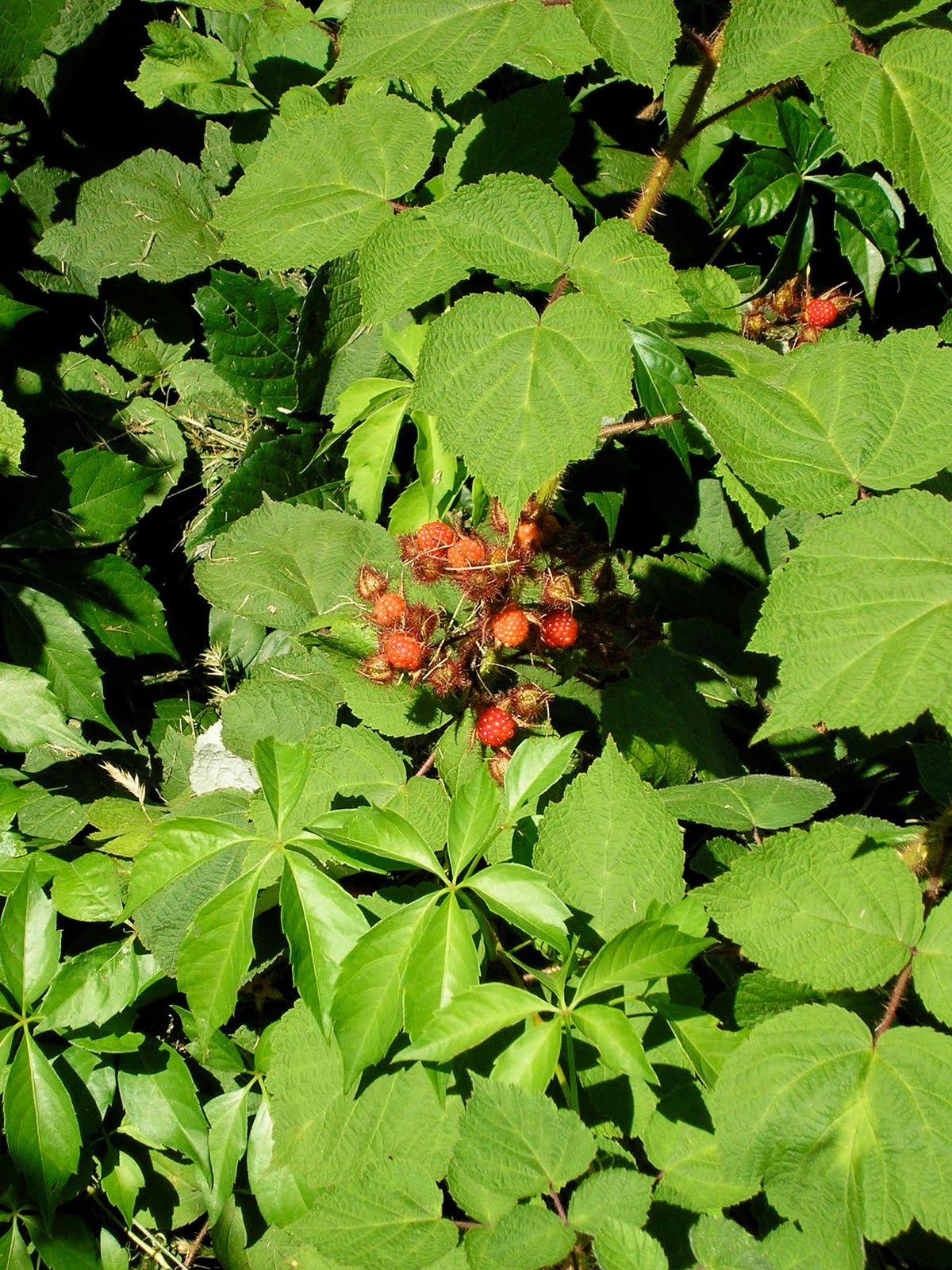
And finally, on the south side of the W&OD bike path just east of Old Reston Avenue one can find this tall shrub with very hairy red stems, compound trifoliate lobed leaves, and red drupes now ripening. This is wineberry (Rubus phoenicolasius, see this Virginia Tech fact sheet and this Wikipedia article), a relative of raspberries and blackberries.
A closer look at wineberries ripening. This plant is nonnative and very invasive, and threatens to displace local raspberries.
Sunday, June 13, 2010
June 8, 2010
This strikingly handsome purple-leaved small tree with wispy flowers is found on the south side of the W&OD bike path immediately west of the American Dream Way bridge. There are several more specimens in the median between the W&OD bike path and the W&OD gravel path near the Fannie Mae Gardens.
This is a smoketree (Cotinus coggygria, see this Virginia Tech fact sheet, NC State fact sheet and this Wikipedia article), which is a relative of the sumacs
In a clearing south of the W&OD bike path across from the Fannie Mae Gardens is a thicket of this plant, whose flower resembles a small thistle but whose leaves and stems are far less spiny. This appears to be a knapweed (Centaurea spp.), and may be the highly invasive spotted knapweed (C. maculosa, see this Missouri description and this Wikipedia article).
Pokeweed (Phytolacca americana) is beginning to bloom, as here on the north side of the W&OD bike path near Isaac Newton Square; see this post from last September for how pokeweed appears once it fruits out.
A couple of small flowering plants hidden in the grass west of the W&OD bike path south of Sunset Hills Drive. The white five-petaled flower with prominent anthers appears to be Carolina horsenettle (Solanum carolinense), already featured before in this post from last October. The small pink-flowered plant next to it with the reddish stem and comparatively large lanceolate leaves appears to be some form of knotweed, perhaps tufted knotweed (Polygonum caespitosum, compare this Virginia Tech weed guide and this Connecticut description), even though the Digital Flora of Virginia does not list this species.
No doubt about this species - this is common milkweed (Asclepias syriaca), now bursting into flower in this thicket on the south side of the W&OD bike path across from the Fannie Mae Gardens.
Close-up of an inflorescence. Compare the Missouri description.
Milkweed flowers are apparently quite popular with insects. Here is a shot with two large butterflies feeding on separate inflorescences; these plants are located in the median between the W&OD bike path and the W&OD gravel path just south of Sunset Hills Drive and north of the Dulles Toll Road bridge.
And here is a shot with a bee of some sort.
This is a smoketree (Cotinus coggygria, see this Virginia Tech fact sheet, NC State fact sheet and this Wikipedia article), which is a relative of the sumacs
In a clearing south of the W&OD bike path across from the Fannie Mae Gardens is a thicket of this plant, whose flower resembles a small thistle but whose leaves and stems are far less spiny. This appears to be a knapweed (Centaurea spp.), and may be the highly invasive spotted knapweed (C. maculosa, see this Missouri description and this Wikipedia article).
Pokeweed (Phytolacca americana) is beginning to bloom, as here on the north side of the W&OD bike path near Isaac Newton Square; see this post from last September for how pokeweed appears once it fruits out.
A couple of small flowering plants hidden in the grass west of the W&OD bike path south of Sunset Hills Drive. The white five-petaled flower with prominent anthers appears to be Carolina horsenettle (Solanum carolinense), already featured before in this post from last October. The small pink-flowered plant next to it with the reddish stem and comparatively large lanceolate leaves appears to be some form of knotweed, perhaps tufted knotweed (Polygonum caespitosum, compare this Virginia Tech weed guide and this Connecticut description), even though the Digital Flora of Virginia does not list this species.
No doubt about this species - this is common milkweed (Asclepias syriaca), now bursting into flower in this thicket on the south side of the W&OD bike path across from the Fannie Mae Gardens.
Close-up of an inflorescence. Compare the Missouri description.
Milkweed flowers are apparently quite popular with insects. Here is a shot with two large butterflies feeding on separate inflorescences; these plants are located in the median between the W&OD bike path and the W&OD gravel path just south of Sunset Hills Drive and north of the Dulles Toll Road bridge.
And here is a shot with a bee of some sort.
Tuesday, June 8, 2010
Late morning of June 4, 2010 (concluded)
A trumpet vine (Campsis radicans) enveloping a yew bush and bursting into radiant flower on the north side of Sunset Hills Road just west of its intersection with the W&OD bike path and east of the Reston post office. See this Missouri description, this Wikipedia article, and this Virginia Tech fact sheet.
Meanwhile, fruit (in the form of raspberries) are starting to set on the blackberry plants (Rubus spp.) that were blooming about a month ago, as shown in this post. This particular specimen is located on the north side of the W&OD bike path just east of its intersection with the Oak Hill Christian School driveway.
Similarly, fruit (i.e., cherries) are beginning to develop on the black cherry trees (Prunus serotina) that were also in bloom about 5 weeks ago, as shown in this post. This plant is located along Sycamore Valley Drive.
Finally, fruit have appeared on mulberry trees, such as this one on Sycamore Valley Drive. Given the glossy upper surface of leaves (which are not lobed, as befits an older specimen), this appears to be white mulberry (Morus alba, see this Wikipedia article, this Morton Arboretum page, and this Virginia Tech fact sheet), the host of the silkworm in ancient China, or one of its many hybrids, rather than the native red mulberry (Morus rubra, see this Virginia Tech fact sheet). Regardless of specific identification, any mulberry tree is easily identifiable by the mess left by the easily squshed fruit on sidewalks beneath them.
Meanwhile, fruit (in the form of raspberries) are starting to set on the blackberry plants (Rubus spp.) that were blooming about a month ago, as shown in this post. This particular specimen is located on the north side of the W&OD bike path just east of its intersection with the Oak Hill Christian School driveway.
Similarly, fruit (i.e., cherries) are beginning to develop on the black cherry trees (Prunus serotina) that were also in bloom about 5 weeks ago, as shown in this post. This plant is located along Sycamore Valley Drive.
Finally, fruit have appeared on mulberry trees, such as this one on Sycamore Valley Drive. Given the glossy upper surface of leaves (which are not lobed, as befits an older specimen), this appears to be white mulberry (Morus alba, see this Wikipedia article, this Morton Arboretum page, and this Virginia Tech fact sheet), the host of the silkworm in ancient China, or one of its many hybrids, rather than the native red mulberry (Morus rubra, see this Virginia Tech fact sheet). Regardless of specific identification, any mulberry tree is easily identifiable by the mess left by the easily squshed fruit on sidewalks beneath them.
Subscribe to:
Posts (Atom)