A bouquet of spiky-headed timothy grass (
Phleum pratense) and blue-colored chicory (
Cichorium intybus, compare this
Missouri description and this
Wikipedia article). According to the Wikipedia article, the chicory, which is often called cornflower by mistake, is related to endive and radicchio. This grouping is found on the south side of the W&OD bike path opposite from the Fannie Mae Gardens.
A bit further west along the W&OD bike path is this rather common plant with stems festooned with hundreds of small, brown, flat, capsule-shaped seeds. This appears to be some sort of dockweed (
Rumex spp.), possibly curled dock (
Rumex crispus, see this
Missouri description and this
Wikipedia article).
A bit further east on the W&OD bike path, just east of the American Dream Way bridge, is this Queen Anne's lace (
Daucus carota, see this
Missouri description and this
Wikipedia article), with its intricate six-sided symmetries and bipinnate leaves. This is the wild carrot that is the ancestor of our cultivated carrot.
This pleasant ornamental bush is planted together with junipers on the south side of the W&OD bike path between American Dream Way bridge and the pipeline easement to screen the large electric power substation there. This is glossy abelia (
Abelia x grandiflora, see the
Virginia Tech fact sheet, this
N.C. State description, and this
Wikipedia article), a common horticultural hybrid that is related to honeysuckles.
A miscellany of vines: trumpet vine (
Campsis radicans) flowers on the right, raspberries (
Rubus spp.) ripening on the lower left, and on the upper left several flowers of the wild potato vine (
Ipomoea pandurata, see this
Missouri description, this
Illinois description, and this
Connecticut description), which is one of the native morning glories, easily identifiable by the wine-colored base at the center of its white flower. This grouping is on the south side of the W&OD gravel path immediately west of its intersection with the Oak Hill Christian School driveway.
Just a few steps further west, on the north side of the W&OD bike path, is this specimen of common mullein (
Verbascum thapsus, see this
excellent Wikipedia article and this
Missouri description) just starting to bloom. The leaves are indeed very fuzzy, and also tear very easily.
Finally a decent picture of eastern gamagrass (
Tripsacum dactyloides), with both male and female flowers visible on the flowerhead in the middle. This particular specimen is on the north side of the W&OD bike path between the Oak Hill Christian School driveway and the pipeline easement.
A larger view of this specimen. The plant appears taller than it is because I was crouching in order to capture the flowerheads against the blue sky; in all, this grass is about 6 feet tall, so that the flowerheads are right at eye-level for me.
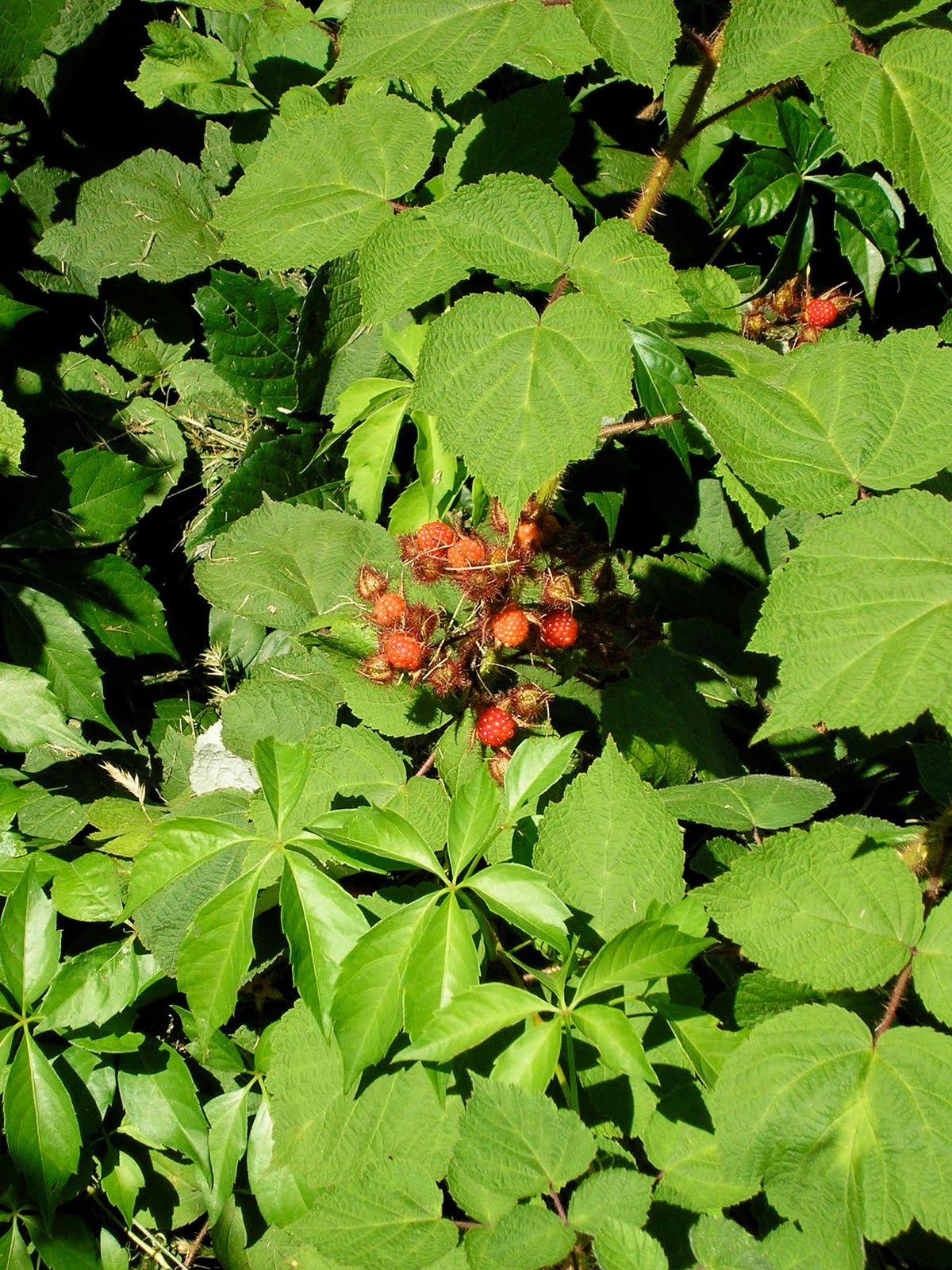
And finally, on the south side of the W&OD bike path just east of Old Reston Avenue one can find this tall shrub with very hairy red stems, compound trifoliate lobed leaves, and red drupes now ripening. This is wineberry (
Rubus phoenicolasius, see this
Virginia Tech fact sheet and this
Wikipedia article), a relative of raspberries and blackberries.
A closer look at wineberries ripening. This plant is nonnative and very invasive, and threatens to displace local raspberries.