A trumpet vine (Campsis radicans) enveloping a yew bush and bursting into radiant flower on the north side of Sunset Hills Road just west of its intersection with the W&OD bike path and east of the Reston post office. See this Missouri description, this Wikipedia article, and this Virginia Tech fact sheet.
Meanwhile, fruit (in the form of raspberries) are starting to set on the blackberry plants (Rubus spp.) that were blooming about a month ago, as shown in this post. This particular specimen is located on the north side of the W&OD bike path just east of its intersection with the Oak Hill Christian School driveway.
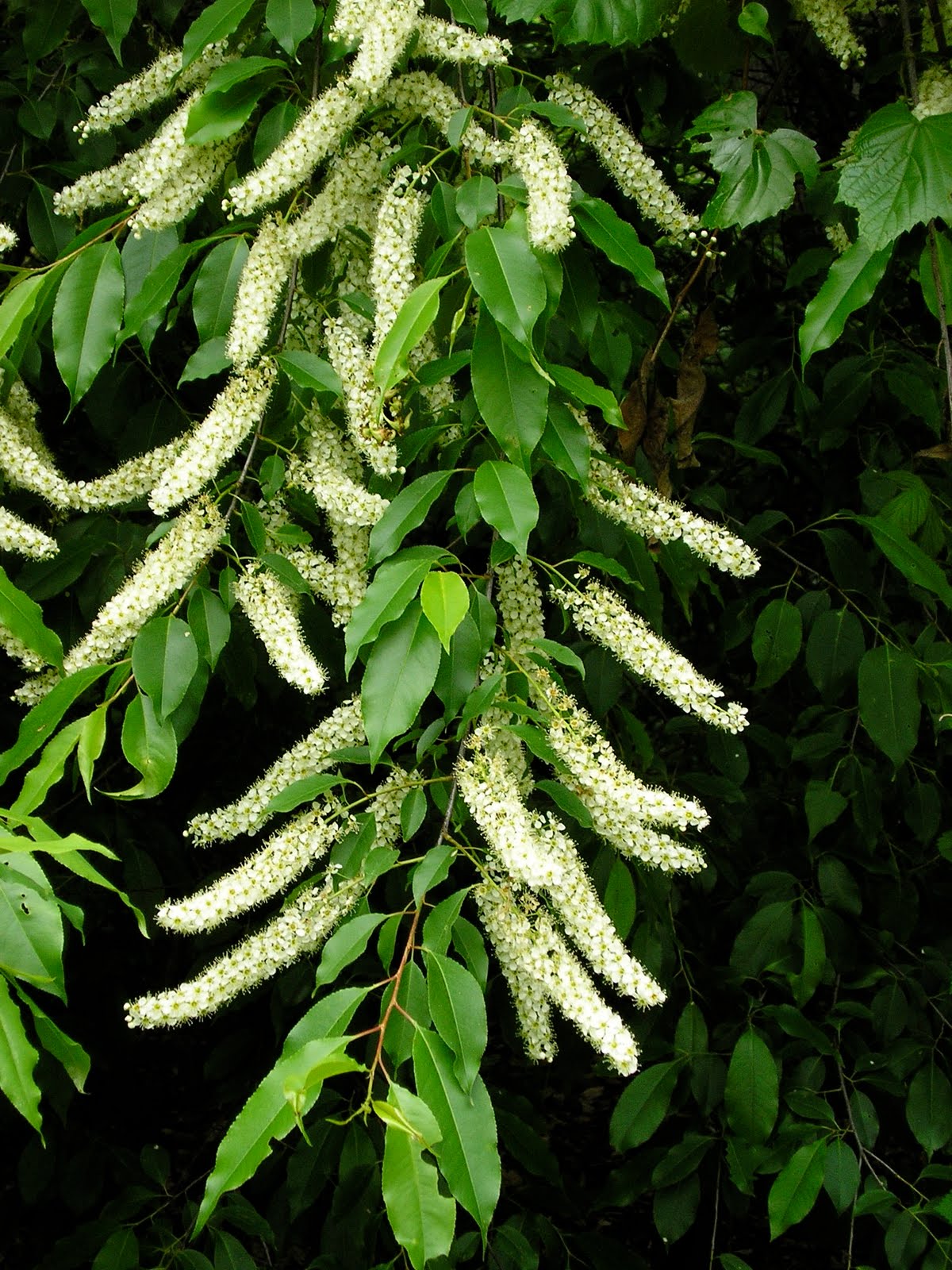
Similarly, fruit (i.e., cherries) are beginning to develop on the black cherry trees (Prunus serotina) that were also in bloom about 5 weeks ago, as shown in this post. This plant is located along Sycamore Valley Drive.
Finally, fruit have appeared on mulberry trees, such as this one on Sycamore Valley Drive. Given the glossy upper surface of leaves (which are not lobed, as befits an older specimen), this appears to be white mulberry (Morus alba, see this Wikipedia article, this Morton Arboretum page, and this Virginia Tech fact sheet), the host of the silkworm in ancient China, or one of its many hybrids, rather than the native red mulberry (Morus rubra, see this Virginia Tech fact sheet). Regardless of specific identification, any mulberry tree is easily identifiable by the mess left by the easily squshed fruit on sidewalks beneath them.
Showing posts with label Prunus spp. (cherries). Show all posts
Tuesday, June 8, 2010
Sunday, April 25, 2010
White flowers (and a couple of yellow ones) - April 25, 2010
Another tree that is blooming spectacularly right now is the black cherry (Prunus serotina - see the Virginia Tech fact sheet). This is a native cherry that grows much taller and blooms rather later than the imported Japanese ornamental varieties. This particular specimen is in the northwestern-most corner of the Charter Oak apartment complex.
Those little white dashes that could be seen in the overview picture? Each one is a panicle full of white five-petaled flowers.
Across North Shore Drive, on the southeastern corner of Temporary Road Park, are these ornamental viburnums, which are almost certainly doublefile viburnum (Viburnum plicatum, see the Virginia Tech fact sheet).
Looking closer at the flower clusters, one can see the large flowers along the outside of each cluster; these large ones are sterile - they lack pistils and stamens, and consist only of petals.
Just north of the intersection of Sycamore Valley Drive with North Shore Drive is this black locust (Robinia pseudoacacia) tree, which allows me a better shot at the drooping white flower clusters than I was able to get day-before-yesterday.
At the edge of the basketball court on North Shore Drive near the border between the Sycamores apartment complex and the Ivy Square condo complex, I found this tiny yellow flower with a very distinctive leaf pattern - three heart-shaped leaves joined at their apex.
Here is another sample, from a meadow in the Charter Oak townhouse complex (this one also properly shows that the flower has five petals). This is a yellow woodsorrel (Oxalis spp.), either common yellow woodsorrel (Oxalis stricta, see this Missouri description) or southern yellow woodsorrel (Oxalis dillenii, see this Missouri description). I am leaning toward believing it to be the latter, as the flowers do seem to be solitary rather than branched.
Just north of the entrance to the Charter Oak townhouse complex is this fringe tree (Chionanthus virginicus, see the Virginia Tech fact sheet). This appears to be a favorite ornamental of local transit agencies; one frequently sees them at Park-and-Ride and Metro station parking lots.
A somewhat closer look at the long stringy white petals which give the fringe tree its name.
Just north of the fringe tree is this ornamental viburnum, which, like the doublefile viburnum pictured earlier, has a ring of sterile flowers ringing the outside of each flower cluster, but which also has three-lobed rather than simple leaves. This appears to be highbush-cranberry (Viburnum opulus var. americanum, see this Vanderbilt description and the Virginia Tech fact sheet). And yes, that is a honeysuckle at the very left of the image.
Finally, I found this small yellow flower (a bit bleached in flashlight) underneath the hollies on the walkway connecting the Charter Oak townhouse complex with the Charter Oak apartments. Note the prominent green sepals separating the five yellow petals, and the trifoliolate compound leaves with rounded serrations. I believe this may be mock strawberry (Duchesnea indica, see this Missouri description), which is closely related to the cinquefoils (Potentilla spp.).
Those little white dashes that could be seen in the overview picture? Each one is a panicle full of white five-petaled flowers.
Across North Shore Drive, on the southeastern corner of Temporary Road Park, are these ornamental viburnums, which are almost certainly doublefile viburnum (Viburnum plicatum, see the Virginia Tech fact sheet).
Looking closer at the flower clusters, one can see the large flowers along the outside of each cluster; these large ones are sterile - they lack pistils and stamens, and consist only of petals.
Just north of the intersection of Sycamore Valley Drive with North Shore Drive is this black locust (Robinia pseudoacacia) tree, which allows me a better shot at the drooping white flower clusters than I was able to get day-before-yesterday.
At the edge of the basketball court on North Shore Drive near the border between the Sycamores apartment complex and the Ivy Square condo complex, I found this tiny yellow flower with a very distinctive leaf pattern - three heart-shaped leaves joined at their apex.
Here is another sample, from a meadow in the Charter Oak townhouse complex (this one also properly shows that the flower has five petals). This is a yellow woodsorrel (Oxalis spp.), either common yellow woodsorrel (Oxalis stricta, see this Missouri description) or southern yellow woodsorrel (Oxalis dillenii, see this Missouri description). I am leaning toward believing it to be the latter, as the flowers do seem to be solitary rather than branched.
Just north of the entrance to the Charter Oak townhouse complex is this fringe tree (Chionanthus virginicus, see the Virginia Tech fact sheet). This appears to be a favorite ornamental of local transit agencies; one frequently sees them at Park-and-Ride and Metro station parking lots.
A somewhat closer look at the long stringy white petals which give the fringe tree its name.
Just north of the fringe tree is this ornamental viburnum, which, like the doublefile viburnum pictured earlier, has a ring of sterile flowers ringing the outside of each flower cluster, but which also has three-lobed rather than simple leaves. This appears to be highbush-cranberry (Viburnum opulus var. americanum, see this Vanderbilt description and the Virginia Tech fact sheet). And yes, that is a honeysuckle at the very left of the image.
Finally, I found this small yellow flower (a bit bleached in flashlight) underneath the hollies on the walkway connecting the Charter Oak townhouse complex with the Charter Oak apartments. Note the prominent green sepals separating the five yellow petals, and the trifoliolate compound leaves with rounded serrations. I believe this may be mock strawberry (Duchesnea indica, see this Missouri description), which is closely related to the cinquefoils (Potentilla spp.).
Tuesday, April 13, 2010
Evening of April 12, 2010 (cont.)
Another tree that is in bloom now is the crabapple (Malus spp., potentially Malus floribunda, the Japanese flowering crabapple). This specimen is located at the entrance to the parking lot of 1801 Robert Fulton Dr and was previously featured in this post from last fall.
A close-up of some of the flowers on this crabapple - the family resemblance to cherries, plums, and pears is quite evident (all are members of the rose family).
On the north side of the W&OD bike path, between Wiehle Ave and Isaac Newton Square, is this wild specimen that I believe is also a crabapple. Being in Reston's weedy wilds rather than on a manicured corporate campus, it is being strangled by grape vines (Vitis spp.); the emerging grape leaves can be seen above the sprig of blossoms.
Another tree that is still spectacularly in flower is the Kwanzan cherry (Prunus serrulata, see the Virginia Tech data sheet), which is the last of the wide-spread Japanese cherries in our area to bloom (the native black cherry, P. serotina, will not bloom for another month or so). This specimen is on the edge of the Cardinal Bank parking lot facing the W&OD bike trail between Sunset Hills Drive and Michael Faraday Drive.
A closer look at the frilly double flower of the Kwanzan cherry.
Ah, what a beauty!
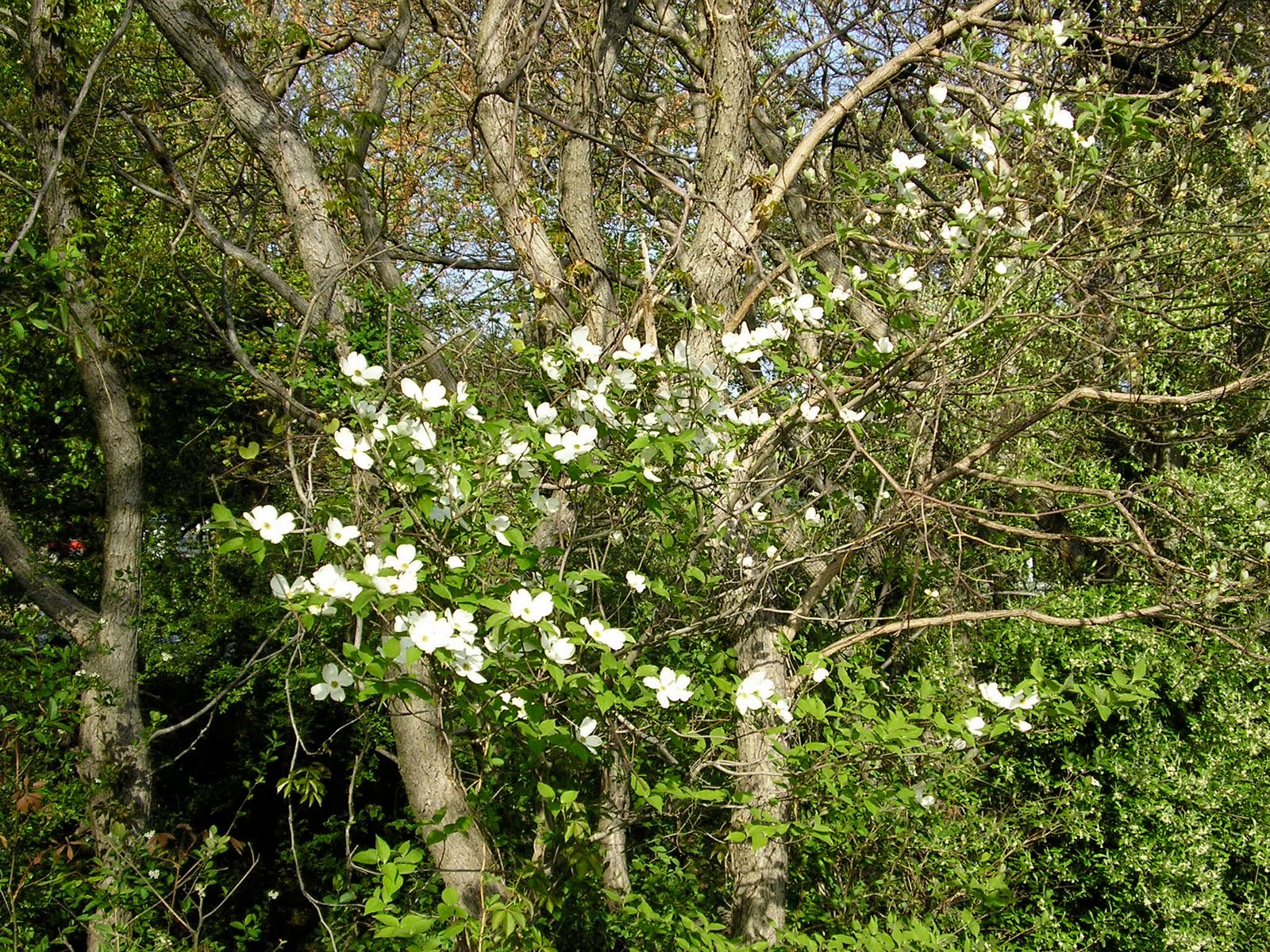
And of course the other charismatic flowering tree of this time of the year is the flowering dogwood (Cornus florida, see the Virginia Tech fact sheet), which together with the eastern redbud dominates the understory. This particular specimen is on the north side of the W&OD bike path just west of Michael Faraday Drive.
A closer look at the characteristic dogwood flower in full development, with the cruciform sepals. For a look at how the dogwood looks in the fall, see this post.
But the most prolifically blooming plant right now may well be the autumn olive (Elaeagnus umbellata, see the Virginia Tech fact sheet), which is highly invasive and festers all up and down the W&OD bike path (this particular specimen is seen from the Cardinal Bank parking lot).
The branches and shoots of this shrub are now all lined with very fragrant flowers whose heavy, sticky smell overpowers the earlier sweeter scent of the pears and cherries. This specimen is just south of the Dulles Toll Road bridge over the W&OD bike path.
A closer look at the autumn-olives abundant flowers. For a look at the equally abundant berry-like fruit generated from these flowers in the fall, see this post.
A close-up of some of the flowers on this crabapple - the family resemblance to cherries, plums, and pears is quite evident (all are members of the rose family).
On the north side of the W&OD bike path, between Wiehle Ave and Isaac Newton Square, is this wild specimen that I believe is also a crabapple. Being in Reston's weedy wilds rather than on a manicured corporate campus, it is being strangled by grape vines (Vitis spp.); the emerging grape leaves can be seen above the sprig of blossoms.
Another tree that is still spectacularly in flower is the Kwanzan cherry (Prunus serrulata, see the Virginia Tech data sheet), which is the last of the wide-spread Japanese cherries in our area to bloom (the native black cherry, P. serotina, will not bloom for another month or so). This specimen is on the edge of the Cardinal Bank parking lot facing the W&OD bike trail between Sunset Hills Drive and Michael Faraday Drive.
A closer look at the frilly double flower of the Kwanzan cherry.
Ah, what a beauty!
And of course the other charismatic flowering tree of this time of the year is the flowering dogwood (Cornus florida, see the Virginia Tech fact sheet), which together with the eastern redbud dominates the understory. This particular specimen is on the north side of the W&OD bike path just west of Michael Faraday Drive.
A closer look at the characteristic dogwood flower in full development, with the cruciform sepals. For a look at how the dogwood looks in the fall, see this post.
But the most prolifically blooming plant right now may well be the autumn olive (Elaeagnus umbellata, see the Virginia Tech fact sheet), which is highly invasive and festers all up and down the W&OD bike path (this particular specimen is seen from the Cardinal Bank parking lot).
The branches and shoots of this shrub are now all lined with very fragrant flowers whose heavy, sticky smell overpowers the earlier sweeter scent of the pears and cherries. This specimen is just south of the Dulles Toll Road bridge over the W&OD bike path.
A closer look at the autumn-olives abundant flowers. For a look at the equally abundant berry-like fruit generated from these flowers in the fall, see this post.
Sunday, April 4, 2010
W&OD Trail, evening of April 2, 2010
Besides the showy ornamentals, such as cherries, pears, and magnolias, there are also many more subtle wonders of nature right now. For example, all up and down the W&OD trail the sassafras trees (Sassafras albidum, see the Virginia Tech fact sheet) are blooming, as in this spectacular example just west of the intersection of the W&OD trail with Michael Faraday Drive.
I did not get a good direct shot of the blossoms, but in this image one gets a sense that the sassafras bloom consists of many tiny six-rayed flowers clumped together in yellowish-green balls.
Meanwhile, in the weedy undergrowth on both sides of the W&OD trail, the devil's walking stick (Aralia spinosa, see the Virginia Tech fact sheet) is busily sprouting. As this post from last fall shows, this plant turns into a quite large shrub. But over the winter most of the year's growth breaks off and decays, leaving a single stick-like stem with the scars from previous years ringed in fierce thorns. In late winter these form forbidding thickets of spiky stems, but over the past couple of weeks green buds have formed on the top of each stick, and these have now opened to reveal this year's growth starting to unfold.
In the southeastern corner of the intersection of the W&OD bike trail with Isaac Newton Square is this beautiful weeping or Higan cherry (Prunus subhirtella, see the Virginia Tech fact sheet) draped over some bike lockers.
This close-up of the blossoms shows the five-fold symmetry, yellow stigma, and reddish calyx as well as the pronounced horizontal lenticels on the stems that clearly identify this as a cherry.
Also quite noticeable now along the W&OD trail and throughout Reston is that the tulip tree (Liriodendron tulipifera) is beginning to leaf out. Four weeks ago, as shown in this posting, branches were bare, graced only with the dried husks of the fruit structures. Those structures are still present, as can be seen in today's picture, but surrounding them now are new young leaves with their characteristic four lobes.
Finally, on the W&OD trail adjoining the Fannie Mae gardens just east of Old Reston Avenue is this magnolia, which I had earlier shown in its bud stage in this posting. The white-blooming tree in the left background is a feral Bradford pear (Pyrus calleryana), while the dull gray-green bush in the right background is the equally invasive autumn olive (Elaeagnus umbellata), which dominates the undergrowth along large stretches of the W&OD trail.
In my earlier posting I had supposed, based purely on the bud, that this might be a Japanese or saucer magnolia. But it clearly is a star magnolia (Magnolia stellata, see the Virginia Tech fact sheet) instead. For a much larger star magnolia, see this posting from a week ago.
Alexander Bell Dr, early evening of April 2, 2010
In the big parking lot at the end of Alexander Bell Drive (just east of the W&OD trail north of its intersection with Sunrise Valley Drive) is this row of purple-leaf plums (Prunus cerasifera, see the Virginia Tech fact sheet), which are widely planted as ornamentals in Reston.
A closer look at the blossoms of the purple-leaf plum; this is from one of the two specimens that flank the entrance to the parking lot of the Access National Bank headquarters at 1800 Robert Fulton Drive. Note the pink petals and the distinctive purple stamens in their midst.
Another widely planted ornamental in Reston is the Bradford pear, a variety of the callery pear (Pyrus calleryana, see the Virginia Tech fact sheet).
This pear has proven to be quite invasive and now frequently goes feral, as here in a thicket between the Alexander Bell Drive parking lot and the W&OD trail. As a result, it has earned a place on Reston's list of eight forbidden species.
Still, one has to admit that the pear flowers are beautiful in their showiness (as well as quite fragrant).
A closer look shows both whitish fringing stamens as well as purple stamens (?) closer to the center; these give a speckled appearance to the blossoms that serve to distinguish them from the Yoshino cherries that are also blooming now.
A look at the underside of the blossoms also shows that the calyx is green rather than pink or red, yet another way to distinguish them from various cherry species.
All across Reston one also sees large trees like this in burgundy or orange-brown, as if colored for the fall. These are red maples (Acer rubrum).
A closer inspection shows that the red color is imparted by the samaras (winged seeds shaped like propellers).
Each red maple tree now bears thousands upon thousands of these seeds, making them among the first plants to complete their reproductive cycle in the spring in Reston - recall that they were blooming only a couple of weeks ago, as shown in this posting (which, incidentally, shows only male flowers - at that time I did not realize that red maples generally bear male and female flowers on separate trees).
A closer look at the blossoms of the purple-leaf plum; this is from one of the two specimens that flank the entrance to the parking lot of the Access National Bank headquarters at 1800 Robert Fulton Drive. Note the pink petals and the distinctive purple stamens in their midst.
Another widely planted ornamental in Reston is the Bradford pear, a variety of the callery pear (Pyrus calleryana, see the Virginia Tech fact sheet).
This pear has proven to be quite invasive and now frequently goes feral, as here in a thicket between the Alexander Bell Drive parking lot and the W&OD trail. As a result, it has earned a place on Reston's list of eight forbidden species.
Still, one has to admit that the pear flowers are beautiful in their showiness (as well as quite fragrant).
A closer look shows both whitish fringing stamens as well as purple stamens (?) closer to the center; these give a speckled appearance to the blossoms that serve to distinguish them from the Yoshino cherries that are also blooming now.
A look at the underside of the blossoms also shows that the calyx is green rather than pink or red, yet another way to distinguish them from various cherry species.
All across Reston one also sees large trees like this in burgundy or orange-brown, as if colored for the fall. These are red maples (Acer rubrum).
A closer inspection shows that the red color is imparted by the samaras (winged seeds shaped like propellers).
Each red maple tree now bears thousands upon thousands of these seeds, making them among the first plants to complete their reproductive cycle in the spring in Reston - recall that they were blooming only a couple of weeks ago, as shown in this posting (which, incidentally, shows only male flowers - at that time I did not realize that red maples generally bear male and female flowers on separate trees).
Saturday, April 3, 2010
Isaac Newton Square, evening of April 2, 2010
At the eastern end of Isaac Newton Square is this glorious row of Yoshino cherries (Prunus x yedoensis) that are now at their peak bloom (no need to go to the Tidal Basin in Washington!).
Ah, what a beautiful display!
This image clearly shows some of the defining characteristics of the cherry blossom - its five-fold symmetry, the single yellow pistil at the center, the light-colored stamens surrounding it, and the somewhat thickened calyx supporting the flower.
Along the south side of the Reston Association headquarters (and mirrored along its north side), right in the center of Isaac Newton Square, is this magnificent double row of saucer magnolias (Magnolia x soulangiana), which is in spectacular bloom this year.
What a wonderful sea of magnolia blossoms (somewhat pinker than the standard variety of saucer magnolia encountered in Reston)!
And yes, as shown in this shot (with colors somewhat bleached by the flash), it is a double row of magnolias - so you can entirely surround yourself with their beauty!
Right around the corner, along the western side of the Reston Association headquarters (you can see some magnolia blossoms at the very right edge of the image), is this sugar maple (Acer saccharum) in full softly-green bloom.
Especially against the backdrop of the magnolia blossoms one can clearly make out the long green drooping stalks that bear the sugar maple flowers. Compare this Vanderbilt site for more on the sugar maple and its flowers.
Ah, what a beautiful display!
This image clearly shows some of the defining characteristics of the cherry blossom - its five-fold symmetry, the single yellow pistil at the center, the light-colored stamens surrounding it, and the somewhat thickened calyx supporting the flower.
Along the south side of the Reston Association headquarters (and mirrored along its north side), right in the center of Isaac Newton Square, is this magnificent double row of saucer magnolias (Magnolia x soulangiana), which is in spectacular bloom this year.
What a wonderful sea of magnolia blossoms (somewhat pinker than the standard variety of saucer magnolia encountered in Reston)!
And yes, as shown in this shot (with colors somewhat bleached by the flash), it is a double row of magnolias - so you can entirely surround yourself with their beauty!
Right around the corner, along the western side of the Reston Association headquarters (you can see some magnolia blossoms at the very right edge of the image), is this sugar maple (Acer saccharum) in full softly-green bloom.
Especially against the backdrop of the magnolia blossoms one can clearly make out the long green drooping stalks that bear the sugar maple flowers. Compare this Vanderbilt site for more on the sugar maple and its flowers.
Subscribe to:
Posts (Atom)