On the east side of the W&OD bike path, just across from the small picnic area south of the Dulles Toll Road, is this isolated little plant with compound flowers composed of a yellow disk in the center and pinkish white rays on the outside.
A close-up of some of the flowers - note the sheer number of small rays on each flower. This is a fleabane, and specifically appears to be a Philadelphia fleabane (Erigeron philadelphicus), based on the pinkish coloration of the rays, the sessile leaves, and the rather hairy stems. See this Missouri description, this Connecticut discussion, and this Illinois disquisition.
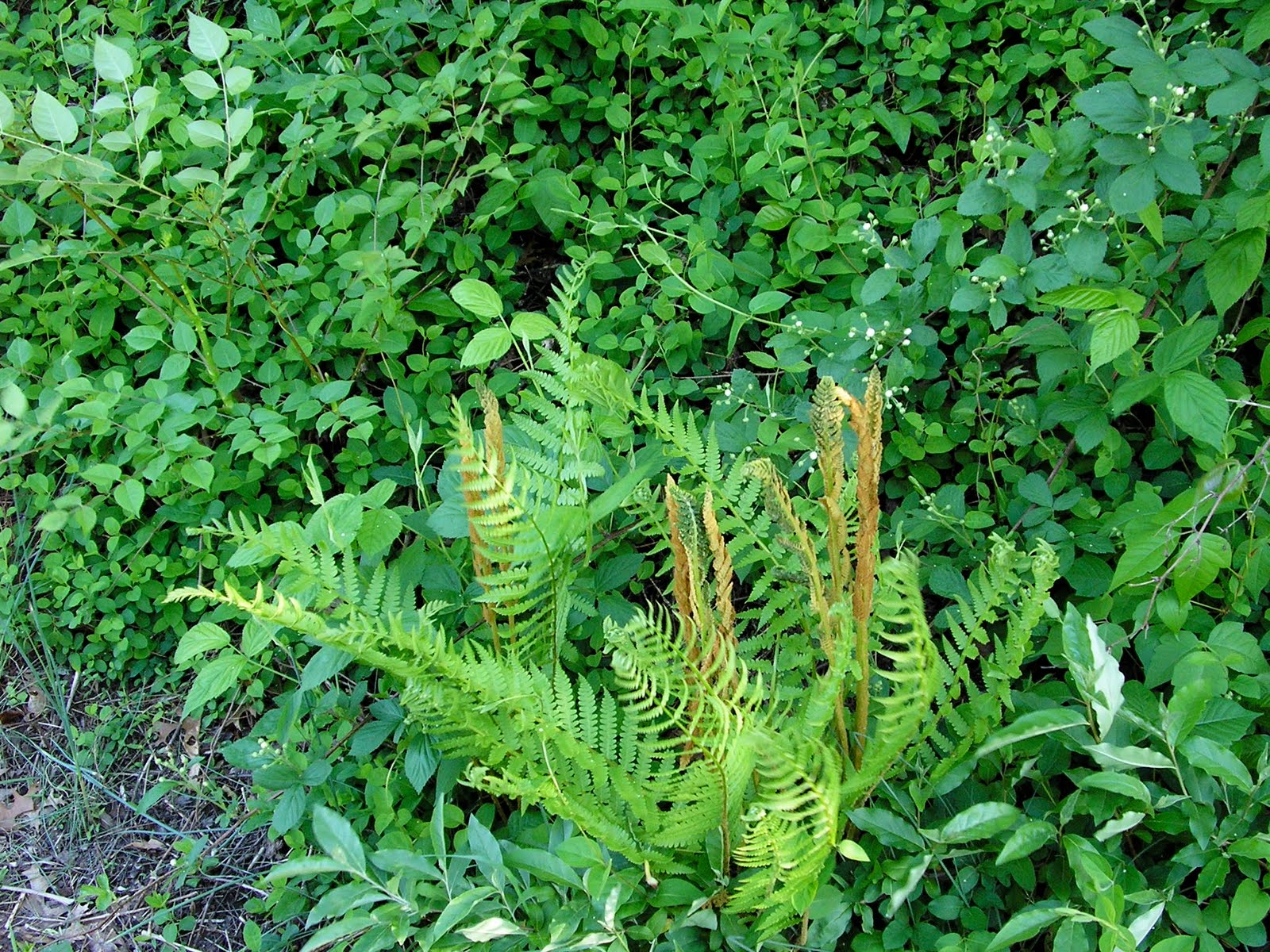
Cinnamon fern (Osmundastrum cinnamomeum) on the north-facing southern slope of the W&OD bike path between Wiehle Avenue and Isaac Newton Square. Note the characteristic stick-like brown frond in the center, which bears the sori that will produce the reproductive spores, and the surrounding green fronds, which are sterile.
Another nearby clump of cinnamon fern. Compare to this post from half a month ago showing the fronds still rolled up in fiddleheads.
A thicket of blackberries (Rubus spp.) erupting into white-petaled bloom north of the W&OD bike path between the Oak Hill Christian School driveway and the pipeline easement. As this Missouri site points out, arching Rubus species can be extremely difficult to distinguish; thus, I will keep it to the generic "blackberry".
A beautiful meadow-effect created by the dispersion of innumerable buttercups (Ranunculus spp.) in the grass that covers the pipeline easement where it crosses the W&OD gravel path (to the left) and W&OD bike path (to the right).
Finally, this little patch along the W&OD bike path across from the Fannie Mae Gardens just east of Old Reston Avenue features both ground ivy (Glechoma hederacea) and red deadnettle (Lamium purpureum), allowing the blue/purple flowers of these two ground-covering weeds to be compared. See this post for an earlier discussion of these two species, as well as the buttercup and the dandelions also visible in this image.
Showing posts with label Osmundastrum spp. (cinnamon ferns). Show all posts
Wednesday, May 5, 2010
Sunday, April 18, 2010
Evening of April 12, 2010 - odds and ends
These ghostly white structures (slightly bleached in the flash) are found on the north-facing slope south of the W&OD bike path between Wiehle Ave and Isaac Newton Square - a very shaded, damp, cool spot. They are so-called "fiddleheads", rolled up new fronds of a fern. See this Wikipedia entry.
Nearby some of the fronds have begun to unroll. Based upon its appearance, as well as some fully unrolled specimens nearby, I think this might be cinnamon fern (Osmundastrum cinnamomeum, formerly Osmunda connamomea, see this Wikipedia entry and this Illinois description). If this identification is correct, then I should be seeing the distinctive cinnamon-colored fertile leaves within the next couple of months.
Meanwhile, the sassafras trees (Sassafras albidum) are nearly finished blooming, and leaves are now emerging from the same bud centers that had borne the flowers. This particular image is from the same tree on the W&OD bike path just west of Michael Faraday Drive that was also featured in this post from 10 days previously.
In a few cases, as on this specimen halfway between Michael Faraday Drive and Sunset Hills Road, one can already see the characteristic trident-shaped leaves emerging in the sassafras.
Near the sassafras in the previous image is this old vine with the new year's growth of three-part leaves beginning to emerge. As the old saying goes, "leaves of three, let it be" - this is poison ivy (Toxicodendron radicans, see the Virginia Tech data sheet).
The devil's walking sticks (Aralia spinosa) that were just beginning to sprout from the winter's remnant stick ten days ago (see this post) have now put on a sizable growth, and the doubly pinnate shape of their large leaves is becoming apparent, as on this specimen on the north side of the W&OD bike path between Wiehle Avenue and Isaac Newton Square.
Further along the bike path, just west of Isaac Newton Square, is a large grove of young ailanthus or Tree of Heaven trees (Ailanthus altissima). Like the devil's walking sticks, the young ailanthus die back to a bare stem in the winter, with new growth sprouting forth from the top in the spring, as shown here. But this species has smooth stems rather than those ferocious spikes and thorns seen on the Aralia!
Subscribe to:
Posts (Atom)