Showing posts with label Pinus spp. (pines). Show all posts

Friday, May 7, 2010

Away from the W&OD

The kousa dogwood (Cornus kousa) at the end of Charter Oak Court is now in full glorious bloom.  For how this very tree looked last September at the height of its fruiting, see this post.


A closer look at the kousa flowers.  These two pictures of the kousa were taken in the evening of May 6, 2010.


At the southeastern corner of Temporary Road park, where the service road intersects North Shore Drive, is a group of shrubs with showy five-petaled pink flowers, as shown in this photo from April 25, 2010.  The compound leaves with usually 7 small leaflets suggest that this is a rose.  Note also that the stems are extremely thorny.  I believe this may be a rugosa rose (Rosa rugosa, see this Virginia Tech fact sheet and the Missouri description).


The tulip trees (Liriodendron tulipifera) are now in full bloom, as here on May 7, 2010, in the Ivy Square townhouse development.


And the eastern white pines (Pinus strobus) are finally developing their male strobili.  Compare this image taken May 7, 2010, in the Ivy Square townhouse development with this post from exactly two weeks previously.

Saturday, April 24, 2010

Trees - April 23, 2010

While male strobili are already fully developed on Virginia pines (see this post from earlier in the week), they are not yet apparent in Eastern white pine (Pinus strobus).  Instead, all we have yet are these new shoots that will eventually develop either male strobili or female cones.


Note, though, how abundant the shoots are, at the end of each branch and branchlet - once the strobili develop, their pollen will be overpowering!  This specimen is in the parking lot of 1801 Robert Fulton Drive.


Meanwhile, this blue spruce (Picea pungens) near the entrance to 1801 Robert Fulton Drive (part of the group featured in this post from last fall) is in full "bloom".


Note the solitary male strobili hanging from the ends of the branches.  Also barely visible are several mature cones from last year that have already opened up and dropped their seed.


Here one can also see a new cone, still light brown and with its scales relatively closed.


Meanwhile, there is one large flowering tree that is now spectacularly in bloom - the black locust (Robinia pseudoacacia, see the Virginia Tech data sheet).


This specimen, which still has few leaves and thus is almost all white flower right now, is located on the north side of the W&OD gravel path just west of its intersection with the driveway for the Oak Hill Christian School.


This specimen is located along the southern border of the Sycamores apartment complex.  It has already leafed out more, showing the characteristic pinnately compound leaves of the black locust.  But this also shows a somewhat closer look at the drooping clusters of flowers - rather similar to the wisteria flowers, which is not surprising, given that both are members of the Fabaceae or pea family.


Near the black locust just shown is this black walnut (Juglans nigra), which is also in bloom, albeit not very spectacularly - note the hanging catkins of green male flowers in the center of the image.


A closer view of the black walnut catkins.  For a picture of black walnut in fruit last fall, see this post.

Thursday, April 22, 2010

Late afternoon of April 20, 2010

First for some of the showy stuff.  Right outside the front entrance of the Access National Bank building at 1800 Robert Fulton Drive these tulips (Tulipa spp.) have been now blooming for more than a week.  There are more than a hundred species and countless cultivars of tulips (see this Wikipedia article), so I'm not even going to attempt to botanize these.


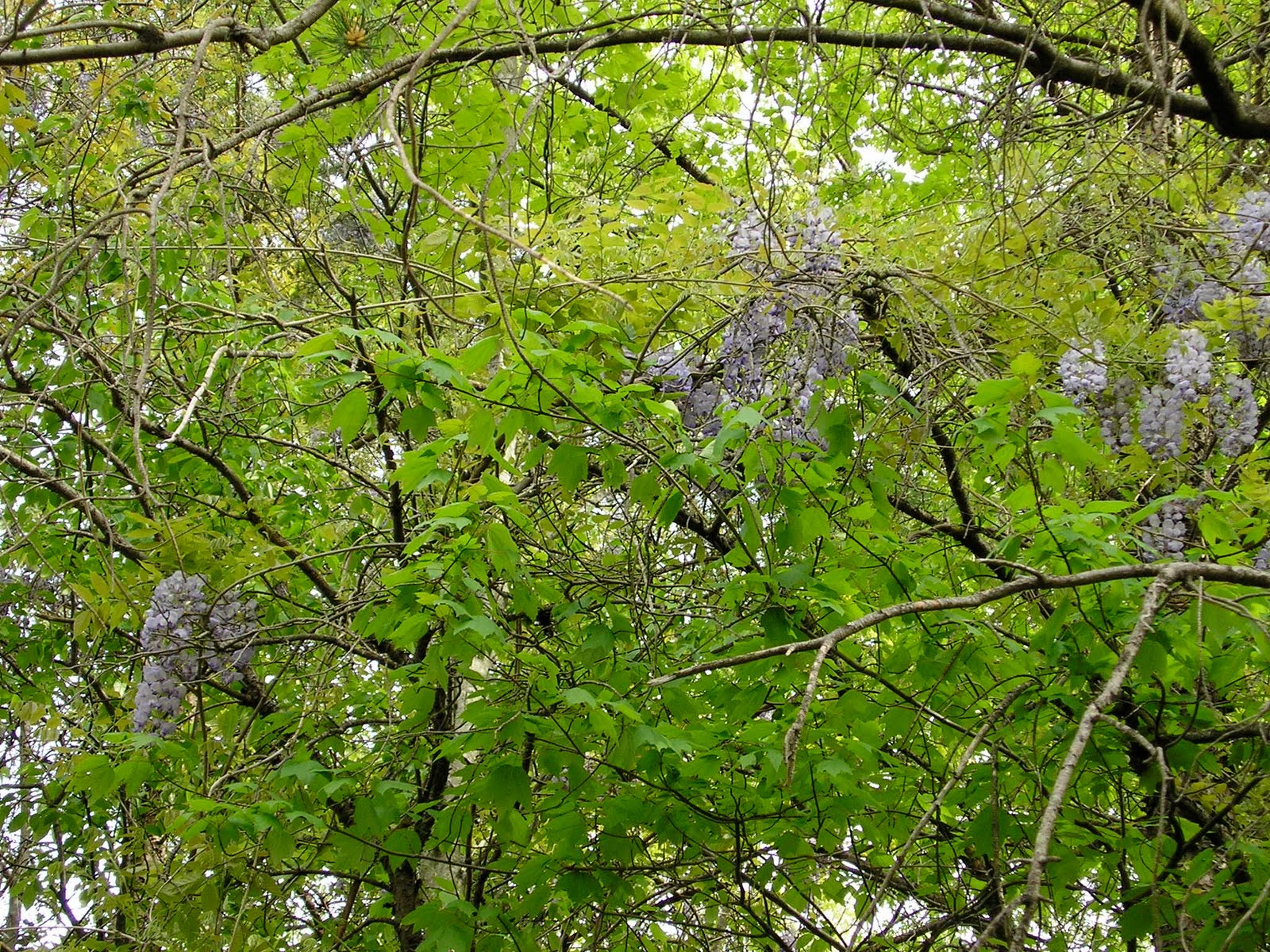
It is now also the season for wisteria (Wisteria spp.) to bloom, as in this specimen at the southwest corner of Sunrise Valley Drive and Cross School Road.  Wisteria are highly invasive vines and are among the eight prohibited plants in Reston.


I am not really able to tell whether this is Chinese wisteria (W. sinensis - see this Virginia Tech fact sheet) or Japanese wisteria (W. floribunda - see this Virginia Tech fact sheet).  The most definitive distinguishing characteristic appears to be the direction in which the vines twine, but I was not able to observe any twining.


However, it would appear that all flowers on the raceme opened at the same time, which would suggest Chinese wisteria.


In open patches of uncultivated grassland, such as this spot between Robert Fulton Drive and the W&OD bike path just north of Sunset Hills Drive, there is also a profusion of this showy yellow plant.


This is common winter cress (Barbarea vulgaris), also known as "yellow rocket" - see this Connecticut description and this Missouri one.  This particular specimen was photographed in the early morning of April 20 along the W&OD bike path north of Sunrise Hills Road.  Note the four-lobed flower and the sessile leaves.


Along the W&OD path one now also frequently encounters this erect, fast-growing plant with opposite, squarish leaves that closely hug the stem.  This is common milkweed (Asclepias syriaca), so named for the milky sap of its main stem.  See this Missouri description, this Virginia Tech weed guide, and this Wikipedia entry.

Added by edit on June 6:  This is not milkweed, but rather Indian hemp (Apocynum cannabinum).  Both have opposite elliptical leaves that cling to a single stem when emerging, but the Indian hemp is more gracile, with leaves spread farther apart.


In certain favored spots, such as here on the slope between Robert Fulton Drive and the W&OD bike path north of the winter cress meadow previously shown, the milkweed forms rather extensive thickets.


Along the W&OD gravel path, as here between Sunrise Valley Drive and the Dulles Toll Road, the  Virginia pine (Pinus virginiana) is also spectacularly in "bloom", with the male strobili fully developed and ready to shed their pollen.


This image shows some of the new strobili adjacent to several old female cones that have long ago dropped their seeds.  Note the recurved spines on each scale of the cones, which are characteristic of this species, together with the short, paired needles.

Saturday, October 24, 2009

Afternoon of October 22, 2009


Right next to the ornamental crabapple trees at the entrance to the parking lot at 1801 Robert Fulton Drive (shown in this posting) is this line of beautiful ornamental conifers - very much the traditional Tannenbaum of my childhood Christmases in Germany.


Given the four-square, rather stiff needles and the fact that the cones are hanging rather than standing erect on the branches, this is very clearly a spruce (Picea spp.) rather than a fir.  Because the branches do not droop, and the foliage (especially this year's new growth) is rather blue in color, I believe this is a blue spruce (Picea pungens).  See the Virginia Tech fact sheet.


The cones tend to be concentrated in the top portion of the tree and can be quite abundant, as seen in this specimen, which is located down the street from the one shown in the first photo and is lighted differently (the tree in the background is an oak).


The blue spruce can be compared with this spruce located in the Charter Oak townhouse development.  Note the drooping branchlets (also note the rather scraggly outline of the tree;  this and all other spruces in the townhouse development were recently pruned).  This is a Norway spruce (Picea abies).  Compare the Virginia Tech fact sheet.


A closer look at the Norway spruce, demonstrating that it is in fact a spruce (note the hanging rather than erect cones) and also suggesting that the cones are rather more elongated than the ones of the blue spruce.


Back on the W&OD bike path, clear evidence that botanical classification actually makes sense!  Thoroughworts (Eupatorium spp.) are members of the Asteraceae family, and thus, just like the thistles, dandelions, and goldenrods that are also classified in this family, the thoroughworts (like this one just south of the Dulles Toll Road bridge) develop white balls of tufted hair to carry off seeds in the wind once flowering has finished.


Another sight of beauty, this one on the north side of the W&OD gravel path at the top of the hill east of Michael Faraday Drive - a wild eastern redcedar (Juniperus virginiana), in full fruit.


Here is a closer look at some of the bluish-white berry-like cones, as well as the four-square branchlets covered in tightly-layered scale-like needles.


Just down the hill, in the northeastern corner of the intersection of the W&OD gravel path with Michael Faraday Drive, is this fascinating pine.  Note the very sharp spike at the end of each cone scale (the cone is quite prickly to the touch).  In this image, you can also see one or two seeds still clinging to the inside of some of the cone scales, especially in the upper right portion of the front cone - the scales themselves are not the trees progeny, but rather the pair of seeds sheltered by each scale.  Also note that the needles are relatively short and come in bundles of two.


On the tree you can find not only this year's new cones, but also quite ancient cones still attached to the tree - this is a pine that does not drop its cones.


In fact, some cones have remained attached for so long that all the scales have been stripped off, leaving just the bare core of the cone hanging on the branch!


Thus, when looking up into this tree, one is struck by the large number of dead cones still remaining.  Based on all of these criteria, this pine, according to Charles Williams's "The Pines of Virginia" (available here), is a Virginia pine or scrub pine (Pinus virginiana).  Also compare the Virginia Tech fact sheet.  This species is an early colonizer of abandoned fields;  thus, it makes sense to find it here along the abandoned railroad.


Compare the Virginia pine with the eastern white pine (Pinus strobus), shown here in a specimen from the north side of North Shore Drive near the Charter Oak townhouse development but very frequently encountered everywhere in Reston.  The eastern white pine has rather longer needles that are in bundles of five;  its cones are also larger, more elongated, and lacking a spine, and they drop after two years.  See the Virginia Tech fact sheet.

Saturday, September 26, 2009

Afternoon of September 25, 2009 (continued)


Overview shot of a large chestnut tree located just east of Reston Parkway on the south side of Bowman Green Drive, which is the circular approach to an early-to-mid 20th century mansion built for the owners of the large farming estate on which the Reston development originated in the 1960s.  I believe this is a Chinese chestnut (Castanea mollissima);  more on identifying characteristics below.  There is another chestnut (somewhat less grand) on the exact opposite side of Bowman Green Drive.


A colleague at work alerted me to the fact that this chestnut is now in full fruit.  Compare with the Virginia Tech fact sheet.


Once the burr-covered fruit ripen and fall from the tree, they will pop open to reveal nuts inside (the nuts here have apparently already been snacked away by the local fauna).  The burrs are huge - see the keys for scale.


View of another fruit-laden branch.  Note also that the undersides of the leaves are much paler than the top sides.  According to this site, this is one of the distinguishing characteristics of Chinese chestnuts as opposed to American chestnuts (Castanea dentata).


A closer look at the underside of a leaf.  Note the relative sparseness of the teeth.  Note also that the very base of the leaf is rounded, so that it meets the vein at roughly right angles rather than at a much sharper angle.  These, too, are characteristics of Chinese chestnuts.  However, as pointed out by this director of the New York Chapter of the American Chestnut Foundation, there has been extensive hybridization among Chinese, American, and European chestnuts over the past two centuries, so the boundaries between the species are no longer very sharp.


Two trees to the east of the chestnut tree on the south side of Bowman Green Drive is this gorgeous river birch (Betula nigra), with its flaking red-orange bark.  Compare the Virginia Tech fact sheet.  According to the key in Richard J. Preston, Jr., and Richard R. Braham, North American Trees, 5th edition (2002), p. 170, river birch is one of only two birches that exfoliates reddish (as opposed to white) bark, and the other (yellow birch, B. alleghaniensis) can be distinguished based on leaf shape.  This type of river birch can be found on both sides of Reston Parkway (for example right outside the Macaroni Grill on the northwest corner of the intersection with New Dominion Parkway, and behind the On the Border Mexican Restaurant in the Spectrum shopping center).  Although river birch is native in this area, these are clearly ornamental plantings, as Reston Parkway is on a ridge rather than in a bottomland, which is the normal setting for these birches.


Closer look at the leaves of this river birch, showing them to be untoothed and wedge-shaped at their base.  Also noticeable in this photo are three green protrusions from the end of the twig.  In birches, male flowers are "preformed", that is, they develop during the fall and remain on the tree throughout the winter until the female flowers emerge in the spring.  I wonder whether these are the beginnings of three male catkins.


Acorns in what I believe to be a pin oak (Quercus palustris) on the west side of Reston Parkway just north of its intersection with Bowman Towne Drive.  Compare the Virginia Tech fact sheet.


Some more acorns in this tree.  The acorns are rather short and stubby, and thus are not Northern red oak (Quercus rubra - see Virginia Tech fact sheet).  Also, the cup appears to my eyes to be saucer-shaped rather than bowl-shaped, which means it is not scarlet oak (Quercus coccinea - see Virginia Tech fact sheet).  Pin oaks are ubiquitous in Reston.


Tall ornamental juniper shrub next to the Chevy Chase bank in the extreme southeastern corner of the Spectrum shopping center.  According to Melanie Choukas-Bradley, City of Trees, The Complete Field Guide to the Trees of Washington, D.C. (3rd ed., 2008), pp. 142-143, the juniper that is by far most commonly encountered around here is the Eastern redcedar (Juniperus virginiana).  Compare with the Virginia Tech fact sheet.


A close-up of this juniper, with the colors somewhat bleached due to the camera flash.  Note the small, closely appressed, scale-like leaves, as well as the round, blueish, berry-like cones - both of these characteristics appear consistent with this being an Eastern redcedar.


Right next to the juniper (which can be seen in the background here) is this ornamental cherry tree (Prunus spp.).  Without flowers I cannot identify the cherry more specifically.  But this tree nicely shows the very distinct horizontal ringing of the bark that makes cherry trees (as a genus) easily identifiable at any time of the year.  Compare this Virginia Tech fact sheet.


A closer view of the shiny bark on a side trunk of this cherry tree.  The distinct horizontal layering is caused by abundant horizontal lenticles, which are openings in the bark through which the tree can exchange water and gases.


One of a line of willow oaks (Quercus phellos) planted along the east side of the Barnes & Noble parking lot adjoining Reston Parkway.  Compare this Virginia Tech fact sheet.


Even though the leaves are willowy-slender and not lobed like other oak leaves, this is still an oak, as can be seen by the presence of acorns (see the three hanging in the middle of this picture).  Note that the acorns are very similar to those of the pin oak (Q. palustris), but the leaf shape of course is very different.


Along the south side of Temporary Road east of Old Reston Avenue is a line of about 5 beautiful ornamental pines.  They have fascicles of two long needles each, so they could be cultivars of Austrian pine (Pinus nigra, compare Virginia Tech fact sheet), Japanese black pine (Pinus thunbergii, compare Virginia Tech fact sheet), or Japanese red pine (Pinus densiflora, compare Virginia Tech fact sheet).  I just love the triangular symmetry of cones and buds on these pines!


Close-up showing a mature cone (which has developed from the female flower) on top and the remnants of male flowers below it.


What I believe you have in this shot are green cones below, which were pollinated this past spring but have not yet been fertilized (it apparently takes a year or so for pollen inside a pine cone to actually fertilize), and new female flowers starting to bud at the top.


Further east on the south side of Temporary Road, at the very northwestern corner of the Temporary Road Recreation Area, is this common persimmon (Diospyros virginiana) in full fruit.


Watch out when stepping underneath this tree!  Once the ripe fruit has fallen (some can be seen in the grassy area), it becomes rather mushy, and when stepped on it leaves behind a big purple splotch, as seen on the sidewalk.