On the west side of the W&OD bike path, just south of its intersection with Sunset Hills Road, is this tall white-flowering shrub. On closer inspection, though, the flowers turn out to have four rather than five petals, and the leaves are simple rather than compound, so this is neither a blackberry nor a rose.
Instead, it is a form of mockorange (Philadelphus spp.). Given the prominent yellow anthers in the flowers, the lack of serration on the leaves, and the shape of the dried four-valved seed capsules visible in this image, this may very well be sweet mockorange (P. coronarius, see this Virginia Tech data sheet and this Connecticut disquisition).
In the median between the W&OD bike path and the W&OD gravel path, immediately south of their intersection with Sunset Hills Road, is this inconspicuous plant with small four-petaled flowers. It is difficult to see in this image, but the leaves are sessile or even clasping. This appears to be a member of the mustard family (Brassica spp.), of which only two species are listed by the Digital Atlas of Virginia Flora as occurring in Fairfax County, and since of those two B. nigra has petiolate leaves, it appears that, by process of elimination, this is a turnip (B. rapa, see this Vanderbilt description). The spiny-appearing upward-pointing projections below the flowers, incidentally, are not leaves or bracts, but rather siliques, which are the characteristic fruits of the mustard family.
Hidden on the east side of the W&OD gravel path north of its intersection with Sunset Hills Road is this inconspicuous plant with blue six-petaled flowers. The leaves look all the world like grass leaves, which is reflected in the plant's name blue-eyed grass (Sisyrinchium spp., see this Wikipedia article), but this is not actually a grass, but rather a relative of the irises and lilies.
On the north side of the W&OD gravel path just east of its intersection with Michael Faraday Drive is a whole row of fleabanes (Erigeron spp.) getting ready to bloom. Given that the ray flowers are white rather than pink, this could be either E. annuus (see Missouri description) or E. strigosus (see Missouri description).
This small ground-covering plant with its characteristic pinnately compound leaves with around 20 leaflets is ubiquitous along the W&OD path. This particular specimen on the north side of the bike path just west of its intersection with Isaac Newton Square has now started blooming. This is crown vetch (Coronilla varia, see the Missouri description), which is a member of the Fabaceae or Pea family, just like the black locust that has similarly-shaped leaves.
Showing posts with label Erigeron spp. (fleabanes). Show all posts
Friday, May 7, 2010
Wednesday, May 5, 2010
Small wonders - late afternoon, April 28, 2010
On the east side of the W&OD bike path, just across from the small picnic area south of the Dulles Toll Road, is this isolated little plant with compound flowers composed of a yellow disk in the center and pinkish white rays on the outside.
A close-up of some of the flowers - note the sheer number of small rays on each flower. This is a fleabane, and specifically appears to be a Philadelphia fleabane (Erigeron philadelphicus), based on the pinkish coloration of the rays, the sessile leaves, and the rather hairy stems. See this Missouri description, this Connecticut discussion, and this Illinois disquisition.
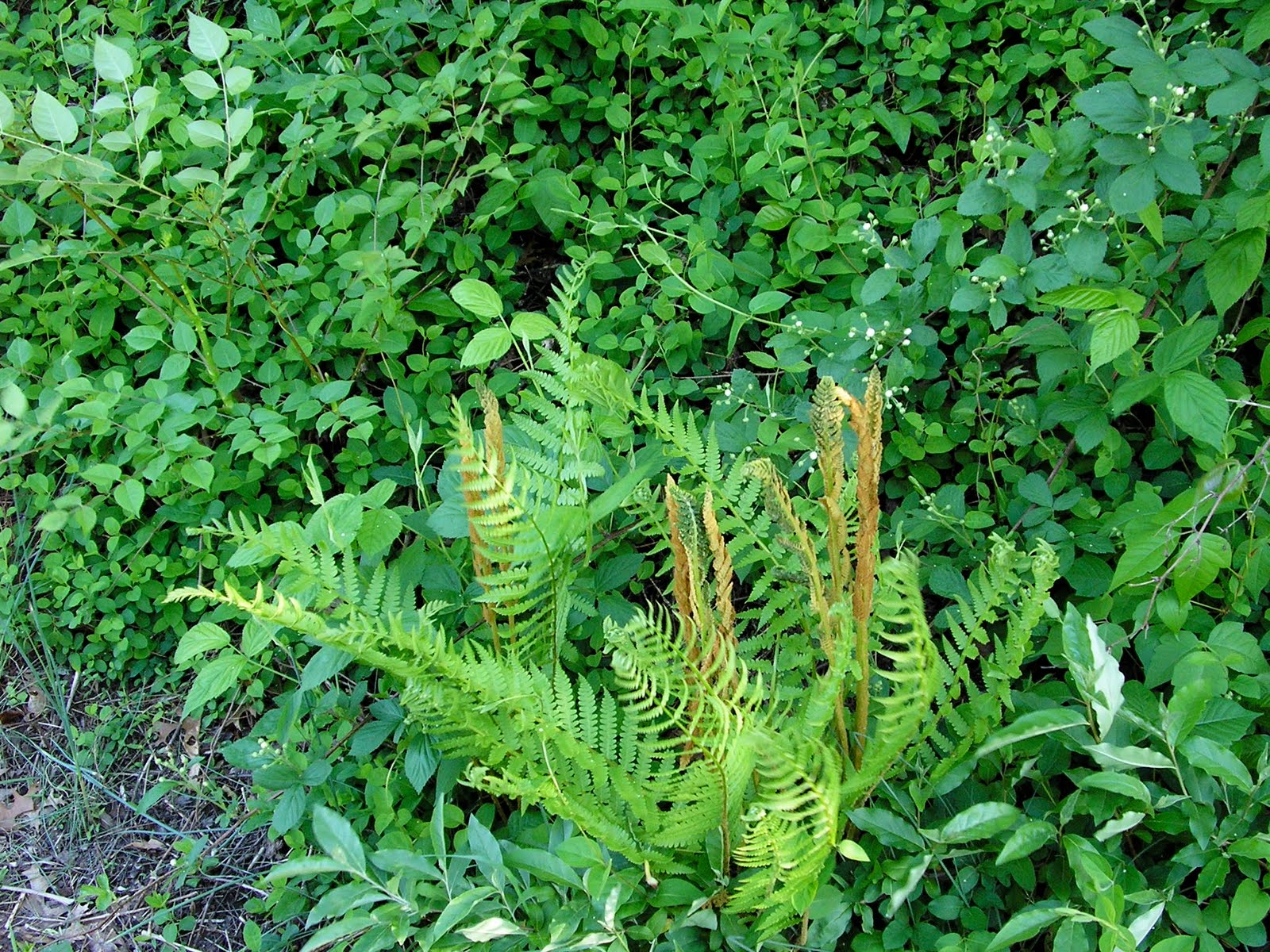
Cinnamon fern (Osmundastrum cinnamomeum) on the north-facing southern slope of the W&OD bike path between Wiehle Avenue and Isaac Newton Square. Note the characteristic stick-like brown frond in the center, which bears the sori that will produce the reproductive spores, and the surrounding green fronds, which are sterile.
Another nearby clump of cinnamon fern. Compare to this post from half a month ago showing the fronds still rolled up in fiddleheads.
A thicket of blackberries (Rubus spp.) erupting into white-petaled bloom north of the W&OD bike path between the Oak Hill Christian School driveway and the pipeline easement. As this Missouri site points out, arching Rubus species can be extremely difficult to distinguish; thus, I will keep it to the generic "blackberry".
A beautiful meadow-effect created by the dispersion of innumerable buttercups (Ranunculus spp.) in the grass that covers the pipeline easement where it crosses the W&OD gravel path (to the left) and W&OD bike path (to the right).
Finally, this little patch along the W&OD bike path across from the Fannie Mae Gardens just east of Old Reston Avenue features both ground ivy (Glechoma hederacea) and red deadnettle (Lamium purpureum), allowing the blue/purple flowers of these two ground-covering weeds to be compared. See this post for an earlier discussion of these two species, as well as the buttercup and the dandelions also visible in this image.
A close-up of some of the flowers - note the sheer number of small rays on each flower. This is a fleabane, and specifically appears to be a Philadelphia fleabane (Erigeron philadelphicus), based on the pinkish coloration of the rays, the sessile leaves, and the rather hairy stems. See this Missouri description, this Connecticut discussion, and this Illinois disquisition.
Cinnamon fern (Osmundastrum cinnamomeum) on the north-facing southern slope of the W&OD bike path between Wiehle Avenue and Isaac Newton Square. Note the characteristic stick-like brown frond in the center, which bears the sori that will produce the reproductive spores, and the surrounding green fronds, which are sterile.
Another nearby clump of cinnamon fern. Compare to this post from half a month ago showing the fronds still rolled up in fiddleheads.
A thicket of blackberries (Rubus spp.) erupting into white-petaled bloom north of the W&OD bike path between the Oak Hill Christian School driveway and the pipeline easement. As this Missouri site points out, arching Rubus species can be extremely difficult to distinguish; thus, I will keep it to the generic "blackberry".
A beautiful meadow-effect created by the dispersion of innumerable buttercups (Ranunculus spp.) in the grass that covers the pipeline easement where it crosses the W&OD gravel path (to the left) and W&OD bike path (to the right).
Finally, this little patch along the W&OD bike path across from the Fannie Mae Gardens just east of Old Reston Avenue features both ground ivy (Glechoma hederacea) and red deadnettle (Lamium purpureum), allowing the blue/purple flowers of these two ground-covering weeds to be compared. See this post for an earlier discussion of these two species, as well as the buttercup and the dandelions also visible in this image.
Subscribe to:
Posts (Atom)