Another tree that is in bloom now is the crabapple (Malus spp., potentially Malus floribunda, the Japanese flowering crabapple). This specimen is located at the entrance to the parking lot of 1801 Robert Fulton Dr and was previously featured in this post from last fall.
A close-up of some of the flowers on this crabapple - the family resemblance to cherries, plums, and pears is quite evident (all are members of the rose family).
On the north side of the W&OD bike path, between Wiehle Ave and Isaac Newton Square, is this wild specimen that I believe is also a crabapple. Being in Reston's weedy wilds rather than on a manicured corporate campus, it is being strangled by grape vines (Vitis spp.); the emerging grape leaves can be seen above the sprig of blossoms.
Another tree that is still spectacularly in flower is the Kwanzan cherry (Prunus serrulata, see the Virginia Tech data sheet), which is the last of the wide-spread Japanese cherries in our area to bloom (the native black cherry, P. serotina, will not bloom for another month or so). This specimen is on the edge of the Cardinal Bank parking lot facing the W&OD bike trail between Sunset Hills Drive and Michael Faraday Drive.
A closer look at the frilly double flower of the Kwanzan cherry.
Ah, what a beauty!
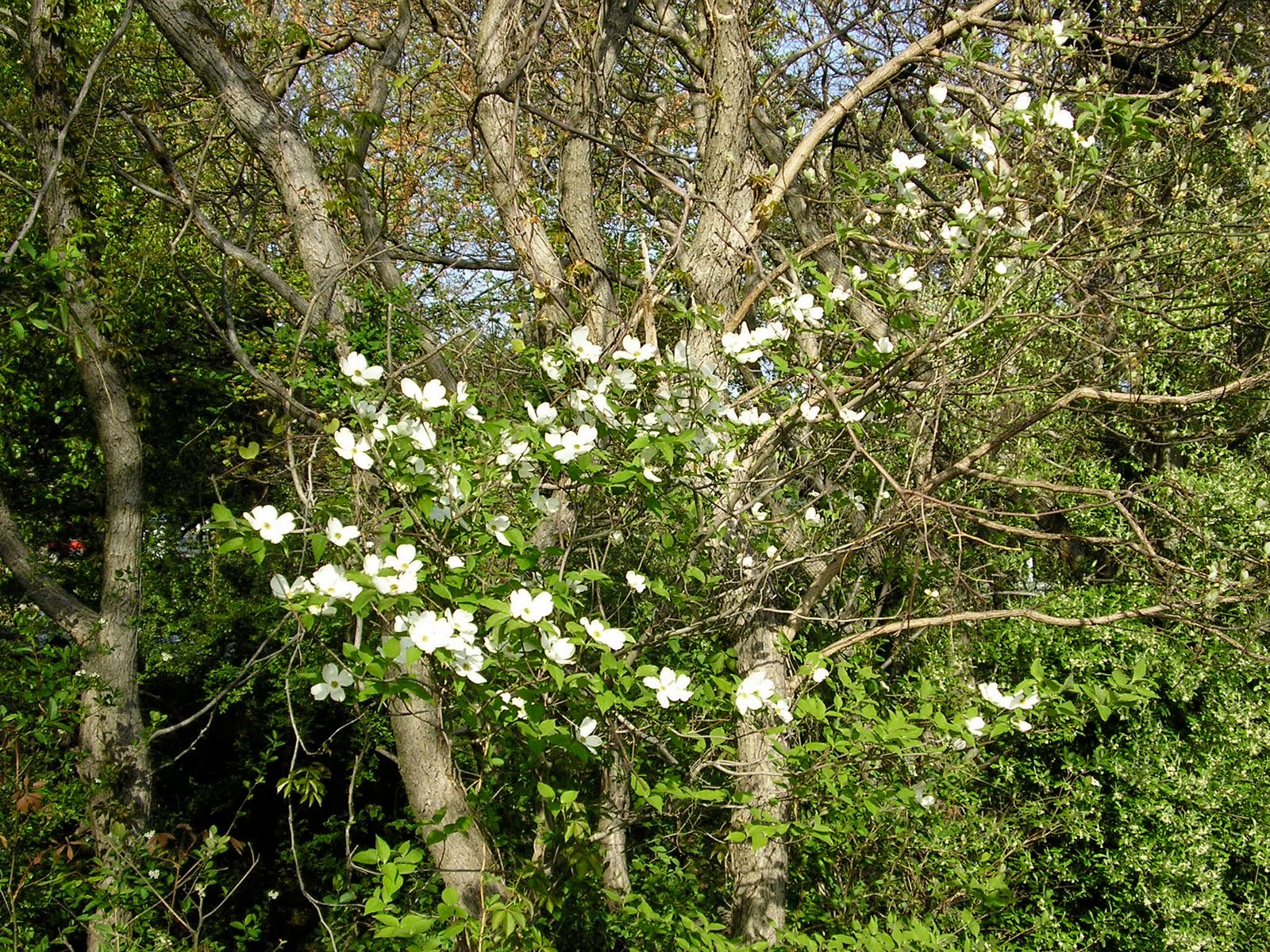
And of course the other charismatic flowering tree of this time of the year is the flowering dogwood (Cornus florida, see the Virginia Tech fact sheet), which together with the eastern redbud dominates the understory. This particular specimen is on the north side of the W&OD bike path just west of Michael Faraday Drive.
A closer look at the characteristic dogwood flower in full development, with the cruciform sepals. For a look at how the dogwood looks in the fall, see this post.
But the most prolifically blooming plant right now may well be the autumn olive (Elaeagnus umbellata, see the Virginia Tech fact sheet), which is highly invasive and festers all up and down the W&OD bike path (this particular specimen is seen from the Cardinal Bank parking lot).
The branches and shoots of this shrub are now all lined with very fragrant flowers whose heavy, sticky smell overpowers the earlier sweeter scent of the pears and cherries. This specimen is just south of the Dulles Toll Road bridge over the W&OD bike path.
A closer look at the autumn-olives abundant flowers. For a look at the equally abundant berry-like fruit generated from these flowers in the fall, see this post.
Showing posts with label Malus spp. (apples). Show all posts
Tuesday, April 13, 2010
Monday, October 5, 2009
Morning of October 5, 2009
Along the W&OD bike path underneath the Dulles Toll Road one can find lots of this plant, a member of the teasel family (Dipsacus spp.). There are two closely related species of teasel that occur in Fairfax County, common teasel (D. fullonum) and cut-leave teasel (D. laciniatus). Common teasel has bracts (the spines at the base of the seedhead) that curve upward, while cut-leave teasel has bracts that stick straight out; common teasel also has leaves that are basically entire, while cut-leave teasel has lobed leaves. Most distinctive, though, is that common teasel blooms pink to lavender, while cut-leave teasel blooms white - seems I missed the season to see this, though. Compare this page from Illinois and this one from Missouri. The seedheads from common teasel, incidentally, used to be used widely in "fulling" wool cloth, that is, napping or scratching it to raise a felt.
A look at some of the lower leaves on this teasel plant. The leaves are large and perfoliate, that is, entirely surrounding the stem, forming a cup in which rainwater may collect. These leaves do look more entire rather than lobed to me, so I think we may in fact be dealing with common teasel here.
A scenery shot, taken in the parking lot of 1801 Robert Fulton Drive, to show the progress of fall coloration in the red maples (Acer rubrum) there.
One of several ornamental fruit trees that flank the entrance to the parking lot of 1801 Robert Fulton Drive.
These trees are now heavily in fruit. When you pierce the fruit with a fingernail, they don't pop open like a cherry, but rather have a firm texture like an apple; thus, I believe this is a crabapple (Malus spp.). See this Wikipedia article and this Michigan State fact sheet.
A look at some of the lower leaves on this teasel plant. The leaves are large and perfoliate, that is, entirely surrounding the stem, forming a cup in which rainwater may collect. These leaves do look more entire rather than lobed to me, so I think we may in fact be dealing with common teasel here.
A scenery shot, taken in the parking lot of 1801 Robert Fulton Drive, to show the progress of fall coloration in the red maples (Acer rubrum) there.
One of several ornamental fruit trees that flank the entrance to the parking lot of 1801 Robert Fulton Drive.
These trees are now heavily in fruit. When you pierce the fruit with a fingernail, they don't pop open like a cherry, but rather have a firm texture like an apple; thus, I believe this is a crabapple (Malus spp.). See this Wikipedia article and this Michigan State fact sheet.
Subscribe to:
Posts (Atom)