American asters (Symphyotrichum spp.) are now in riotous bloom all along sidewalks and roadsides, if you but look low below the trees. Goldenrods (Solidago spp.), in contrast, have pretty much faded by now. This particular clump of asters is to be found in the Sycamores apartment complex.
A hedge of holly (Ilex spp.) on the west side of Old Reston Avenue, south of its intersection with Stratford Park Place, right at the bus stop for the RIBS 2 bus.
A closer look reveals that this plant bears red berries, mostly in clumps in the leaf axils. Based on the relatively large number of spiny teeth on the leaves, and the rather pointed leaf tip, I believe this may be a specimen of Foster's holly (Ilex x attenuata), an ornamental hybrid. Compare the Virginia Tech fact sheet.
This holly specimen is located along the pathway connecting the Charter Oak apartment complex with the Charter Oak townhomes to the south. These leaves are larger, thicker, darker, and less spiny; also note that the fruit have not yet matured. I believe this may be a cultivar of Chinese holly (Ilex cornuta); compare the Virginia Tech fact sheet.
A winged burningbush (Euonymus alatus) at the northwestern corner of the intersection of Old Reston Avenue with the W&OD bike path. It is called "burningbush" because it turns a beautiful fire-red in the fall. Despite its beauty (and consequent wide horticultural use), this is a very invasive exotic that is on Reston's list of 8 forbidden species.
And yes, this one also has a red fruit, although this is not a berry or drupe, but rather an aril that is revealed when the husk around it splits open (remnants of the husk are still attached to this fruit). Compare the Virginia Tech fact sheet. The winged burningbush can be distinguished from native burningbushes by the distinctive wings of cork on its stems; unfortunately, I did not manage to get a good picture of the wings.
At the southwestern corner of the same intersection is this solitary specimen of common evening primrose (Oenothera biennis), with several faded goldenrods and lots of grape leaves behind it. As suggested by its name, this was flowering close to sunset. Compare this description from Illinois.
Sycamores (Platanus spp.) are quite prominent in this section of Reston. This specimen, with its characteristically mottled bark, is on the east side of Old Reston Avenue just north of the intersection with American Dream Way.
Unfortunately, it appears that the local sycamores are quite susceptible to disease. The leaves are frequently brown, splotched, raggedy, full of holes, or otherwise stressed-looking.
Based on the leaf shape, with its rather shallow lobes and large number of teeth, and the singly-hanging fruit as seen in this image, I believe the sycamores here are American sycamores (Platanus occidentalis). Compare the Virginia Tech fact sheet.
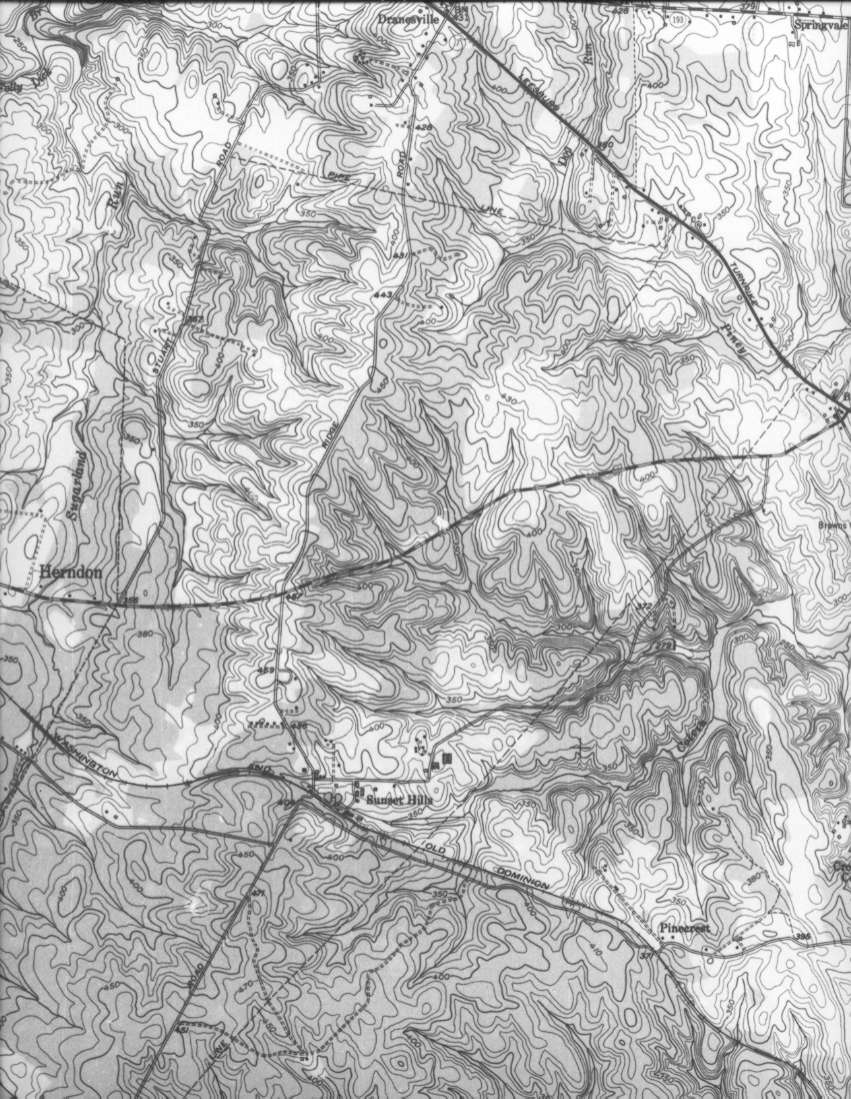
Extending along the driveway/gravel path north of the former Sallie Mae property along the southern edge of the Ivy Oak townhomes, and reaching all the way from Old Reston Avenue to the pocket park on North Shore Drive, is this gorgeous row of large, mature sycamores. Further east, flanking the western portion of Links Drive north of North Shore Drive, there is another double row of mature sycamores. This map of Reston from 1951 shows this trajectory to have coincided with a road leading from the old turn-of-the-century settlement of Sunset Hills to some outlying farm buildings. It is likely that that old road was lined with sycamores, and thus these trees are a remaining witness to the way Reston was before suburban development hit with a vengeance in the 1960s.
Showing posts with label Symphyotrichum spp. (American asters). Show all posts
Monday, October 12, 2009
Sunday, September 27, 2009
Afternoon of September 27, 2009
The following pictures were taken near the eastern end of the hedgerow on the northern side of the Charter Oak apartment complex that separates the complex from the Hidden Creek Country Club golf course to the north.
Most of the trees in this hedgerow are tulip trees, also known as yellow poplars or tulip poplars (Liriodendron tulipifera). They are instantly recognizable by their unique large four-lobed leaves. Compare the Virginia Tech fact sheet. The bud-like structure in the center of this picture is the fruit of this tree, consisting of numerous samaras that will apparently float off in the next month or so.
In the understory there is this isolated occurrence of tree of heaven (Ailanthus altissima). Compare the Virginia Tech fact sheet. This is a highly invasive weed species; see this National Park Service fact sheet for details.
The large brown structures are the remnants of its seed pods; from their size and number you can tell that this tree is a prolific seed producer, which is what makes it such a success as a weed.
Tree of heaven has large pinnately compound leaves, much like walnuts and sumacs. The way you can tell a tree of heaven leaf is that each leaflet is smooth-edged except for a distinct notch near the base on both sides of the leaflet. Walnuts and sumacs, by contrast, have serrate (finely toothed) leaflets.
Just beginning to bloom at ground level is this small-flowered white-rayed aster (Symphyotrichum spp.). There are a large number of asters, which are apparently difficult to distinguish. Cross-referencing the small-flowered white-rayed asters listed in Newcomb's Wildflower Guide to those listed as growing wild in Fairfax County in the Digital Atlas of Virginia Flora, it appears this could be either calico aster (Symphyotrichum lateriflorum - see this description from the Connecticut Botanical Society) or frost aster (Symphyotrichum pilosum - see this description from the Connecticut Botanical Society).
The hedgerow also features several black walnuts (Juglans nigra), which are now magnificently in fruit; the green husks, which contain the walnut, are about 2-3 inches across. Compare the Virginia Tech fact sheet. Note that this is black walnut, and not butternut (J. cinerea), as the fruit are round rather than lemon-shaped. Black walnut is found not infrequently in the wild woods of Reston.
Virginia creeper (Parthenocissus quinquefolia), with its distinctive five-part palmately compound leaf, is the dominant vine in this hedgerow. Here it can be seen as both ground cover as well as climbing the trunk of a tulip tree. This is the view from my living room window.
The dominant maple in both the hedgerow and the landscaped portions of the Charter Oak apartment complex is the red maple (Acer rubrum). But the hedgerow also contains this sugar maple (Acer saccharum), with the leave shape familiar to us from the Canadian flag. Compare the Virginia Tech fact sheet.
Toward the very eastern end of the hedgerow is yet another species of maple, the silver maple (Acer saccharinum), whose large leaf is deeply dissected. Compare the Virginia Tech fact sheet. The only other silver maple I have noticed so far in Reston is in the Charter Oak Townhomes complex. In this image (which was taken pointing straight up), also note the pinnately compound leaves of a black walnut higher up in the canopy.
Most of the trees in this hedgerow are tulip trees, also known as yellow poplars or tulip poplars (Liriodendron tulipifera). They are instantly recognizable by their unique large four-lobed leaves. Compare the Virginia Tech fact sheet. The bud-like structure in the center of this picture is the fruit of this tree, consisting of numerous samaras that will apparently float off in the next month or so.
In the understory there is this isolated occurrence of tree of heaven (Ailanthus altissima). Compare the Virginia Tech fact sheet. This is a highly invasive weed species; see this National Park Service fact sheet for details.
The large brown structures are the remnants of its seed pods; from their size and number you can tell that this tree is a prolific seed producer, which is what makes it such a success as a weed.
Tree of heaven has large pinnately compound leaves, much like walnuts and sumacs. The way you can tell a tree of heaven leaf is that each leaflet is smooth-edged except for a distinct notch near the base on both sides of the leaflet. Walnuts and sumacs, by contrast, have serrate (finely toothed) leaflets.
Just beginning to bloom at ground level is this small-flowered white-rayed aster (Symphyotrichum spp.). There are a large number of asters, which are apparently difficult to distinguish. Cross-referencing the small-flowered white-rayed asters listed in Newcomb's Wildflower Guide to those listed as growing wild in Fairfax County in the Digital Atlas of Virginia Flora, it appears this could be either calico aster (Symphyotrichum lateriflorum - see this description from the Connecticut Botanical Society) or frost aster (Symphyotrichum pilosum - see this description from the Connecticut Botanical Society).
The hedgerow also features several black walnuts (Juglans nigra), which are now magnificently in fruit; the green husks, which contain the walnut, are about 2-3 inches across. Compare the Virginia Tech fact sheet. Note that this is black walnut, and not butternut (J. cinerea), as the fruit are round rather than lemon-shaped. Black walnut is found not infrequently in the wild woods of Reston.
Virginia creeper (Parthenocissus quinquefolia), with its distinctive five-part palmately compound leaf, is the dominant vine in this hedgerow. Here it can be seen as both ground cover as well as climbing the trunk of a tulip tree. This is the view from my living room window.
The dominant maple in both the hedgerow and the landscaped portions of the Charter Oak apartment complex is the red maple (Acer rubrum). But the hedgerow also contains this sugar maple (Acer saccharum), with the leave shape familiar to us from the Canadian flag. Compare the Virginia Tech fact sheet.
Toward the very eastern end of the hedgerow is yet another species of maple, the silver maple (Acer saccharinum), whose large leaf is deeply dissected. Compare the Virginia Tech fact sheet. The only other silver maple I have noticed so far in Reston is in the Charter Oak Townhomes complex. In this image (which was taken pointing straight up), also note the pinnately compound leaves of a black walnut higher up in the canopy.
Subscribe to:
Posts (Atom)