Showing posts with label Viburnum spp. (viburnums). Show all posts

Sunday, April 25, 2010

White flowers (and a couple of yellow ones) - April 25, 2010

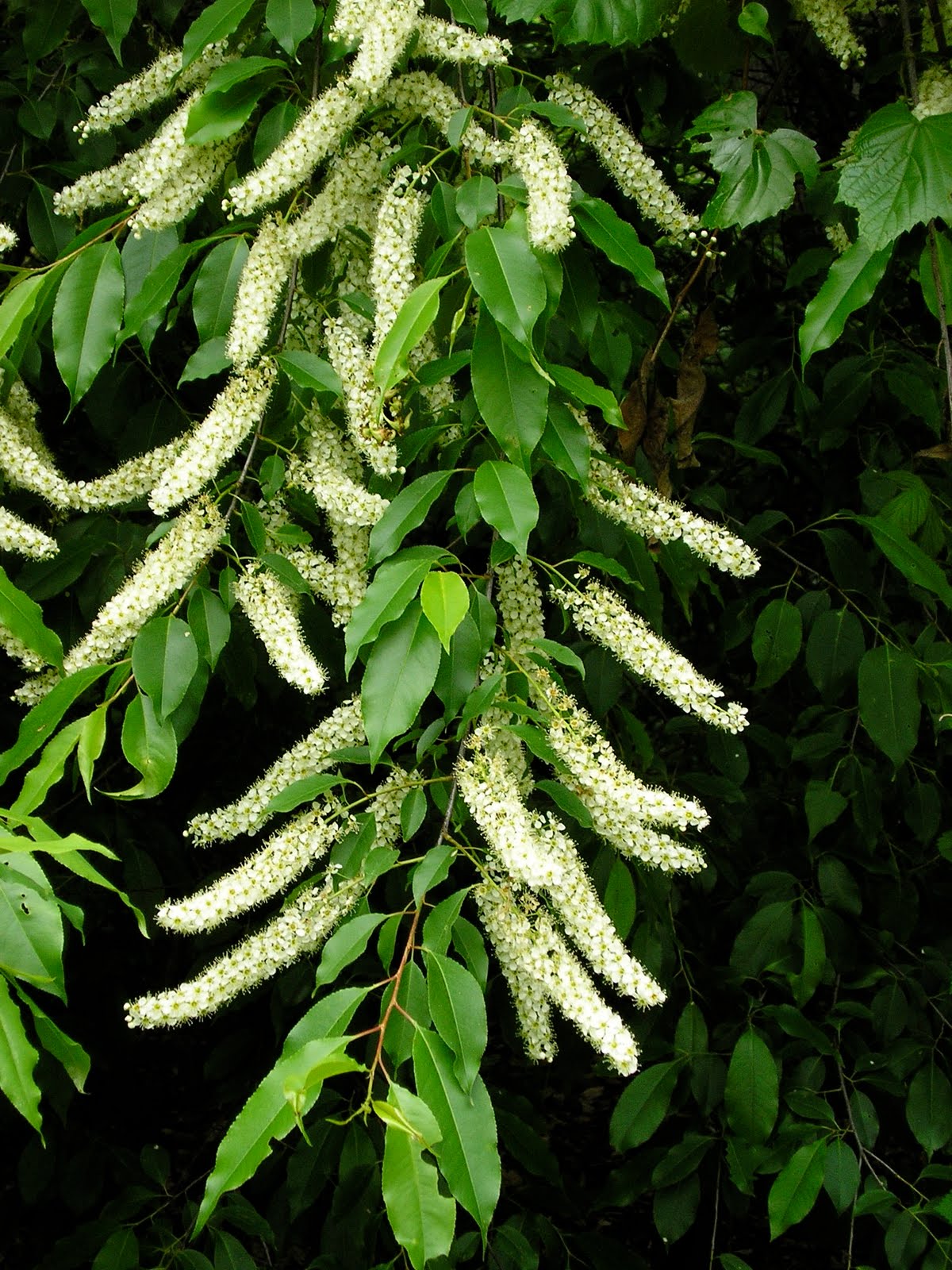
Another tree that is blooming spectacularly right now is the black cherry (Prunus serotina - see the Virginia Tech fact sheet).  This is a native cherry that grows much taller and blooms rather later than the imported Japanese ornamental varieties.  This particular specimen is in the northwestern-most corner of the Charter Oak apartment complex.


Those little white dashes that could be seen in the overview picture?  Each one is a panicle full of white five-petaled flowers.


Across North Shore Drive, on the southeastern corner of Temporary Road Park, are these ornamental viburnums, which are almost certainly doublefile viburnum (Viburnum plicatum, see the Virginia Tech fact sheet).


Looking closer at the flower clusters, one can see the large flowers along the outside of each cluster;  these large ones are sterile - they lack pistils and stamens, and consist only of petals.


Just north of the intersection of Sycamore Valley Drive with North Shore Drive is this black locust (Robinia pseudoacacia) tree, which allows me a better shot at the drooping white flower clusters than I was able to get day-before-yesterday.


At the edge of the basketball court on North Shore Drive near the border between the Sycamores apartment complex and the Ivy Square condo complex, I found this tiny yellow flower with a very distinctive leaf pattern - three heart-shaped leaves joined at their apex.


Here is another sample, from a meadow in the Charter Oak townhouse complex (this one also properly shows that the flower has five petals).  This is a yellow woodsorrel (Oxalis spp.), either common yellow woodsorrel (Oxalis stricta, see this Missouri description) or southern yellow woodsorrel (Oxalis dillenii, see this Missouri description).  I am leaning toward believing it to be the latter, as the flowers do seem to be solitary rather than branched.


Just north of the entrance to the Charter Oak townhouse complex is this fringe tree (Chionanthus virginicus, see the Virginia Tech fact sheet).  This appears to be a favorite ornamental of local transit agencies;  one frequently sees them at Park-and-Ride and Metro station parking lots.


A somewhat closer look at the long stringy white petals which give the fringe tree its name.


Just north of the fringe tree is this ornamental viburnum, which, like the doublefile viburnum pictured earlier, has a ring of sterile flowers ringing the outside of each flower cluster, but which also has three-lobed rather than simple leaves.  This appears to be highbush-cranberry (Viburnum opulus var. americanum, see this Vanderbilt description and the Virginia Tech fact sheet).  And yes, that is a honeysuckle at the very left of the image.


Finally, I found this small yellow flower (a bit bleached in flashlight) underneath the hollies on the walkway connecting the Charter Oak townhouse complex with the Charter Oak apartments.  Note the prominent green sepals separating the five yellow petals, and the trifoliolate compound leaves with rounded serrations.  I believe this may be mock strawberry (Duchesnea indica, see this Missouri description), which is closely related to the cinquefoils (Potentilla spp.).

Saturday, April 24, 2010

Understory - April 23, 2010

North of the W&OD gravel path, between the pipeline easement and American Dream Way, is this rather tall flowering herb with very serrated opposite triangular leaves, four-petaled white flowers, and spiny bracts.  This appears to be garlic mustard (Alliaria petiolata, see this Missouri description), which is considered a bad invasive plant (see this link).


Nearby is this specimen, which has denser, less serrated leaves and no bracts, but I believe it may still be the same species.


On the south side of the W&OD bike path, just east of its intersection with Michael Faraday Drive, is this viburnum bush (Viburnum spp.) that was already featured in full fruit in this post last fall.  Back then I suggested this might be wayfaringtree viburnum (V. lantana), although I'm now thinking it might also be leatherleaf viburnum (V. rhytidophyllum, see the Virginia Tech data sheet).  Unfortunately, I did not pay attention during the winter as to whether this was evergreen or not.

Thursday, April 22, 2010

Late afternoon of April 20, 2010 (continued)

As a ground cover on the sun-receiving north side of the W&OD bike path one now frequently encounters this five-petaled white flower, which is associated with serrated three-lobed or trifoliate compound leaves.  I believe this is dewberry (Rubus flagellaris, see this Virginia Tech fact sheet and this Missouri description).


This plant forms long trailing or flat-lying vines which, as I verified by hand, have curved prickles along them.


Also bursting forth into flower all along the W&OD bike path now is the Amur honeysuckle (Lonicera maackii, see the Virginia Tech fact sheet), as seen here east of Michael Faraday Drive.  For a view of the prolific berries of this plant in the fall, see this earlier post.


This is a bush honeysuckle rather than a vine honeysuckle, so it is not Japanese honeysuckle (L. japonica), and the petals are not evenly spaced around the flower, so this is not Morrow's honeysuckle (L. morrowii).  Instead, four of the petals are fused into an upper lobe, which is characteristic of the Amur honeysuckle.


Another invasive species blooming profusely right now is the winged burningbush (Euonymus alatus), which has rather small, inconspicuous yellowish-green four-petaled flowers.  It is far more noticeable in the fall, when its leaves turn a bright burning red, as seen in this post from last fall.


On this particular specimen, which is a feral plant on the north side of the W&OD bike path east of Michael Faraday Drive, the wings of cork that give this species its name are also very noticeable, far more so than on the ornamental specimen in this post.  As this very informative Ohio State article points out, the wings that are very distinctive in the wild-type have been largely bred out of the "compacta" cultivar that is most commonly used for ornamental plantings.


Meanwhile, poison ivy is not yet in bloom, although the developing flower buds can be clearly seen in this image from east of Michael Faraday Drive.


Finally, in the southwestern corner of the intersection of the W&OD bike path with Michael Faraday Drive is this hydrangea  plant in full snowball bloom.  The leaves are lobed, and thus it appears to be some form of oak-leaved hydrangea (Hydrangea quercifolia), but the leaves are much smaller, and the flowers are blooming much earlier than those on the ornamental specimens near Plaza America featured in this post from last fall.  There are many cultivars of hydrangea bred by humans, and thus the specific identification is beyond my means right now.

Added by edit April 25, 2010:  Oh, how embarassing!  This is not a hydrangea at all, but rather a snowball bush cultivar of the European cranberrybush viburnum (Viburnum opulus var. opulus, see the Virginia Tech fact sheet and this Missouri gardening site).

Sunday, October 25, 2009

Afternoon of October 22, 2009 (continued)

On the south side of the W&OD bike path, just east of its intersection with Michael Faraday Drive, and hidden among the mile-a-minute vines that are now dying back, is this full-in-fruit shrub, which appears to me to be a viburnum.  More specifically, this might be a wayfaring bush (Viburnum lantana), based on the red color of the fruit on their terminal clusters (we have not had our first autumn frost yet) and the rather narrow shape of the leaves.  Compare the Virginia Tech fact sheet and this page from Washington State University, which, however, shows rather broader leaves.


As one enters the oak-hickory forest of Lake Fairfax Park on the path that extends north from Michael Faraday Drive, one soon encounters mossy patches.  Here is an extreme close-up, which  shows that the moss patch is more than just velvety green;  there is actual structure, with branched stems.  I have to admit that I have no idea about the proper classification of this organism;  I am not even sure whether it is a true moss (division Bryophyta) or a spikemoss (genus Selaginella).  Lots of room for further education here!


O.k., back to vascular plants.  This specimen is on the south side of the Reston Association path from Tall Oaks shopping center just before it crosses North Shore Drive south of the Golf Course Island pool.  This is clearly a smartweed (Persicaria spp.) of some kind, but I am not sure about the species.  Note the dark splotch in the center of one of the leaves;  this would support identification as Lady's thumb (Persicaria maculosa), but the sheath around the leave nodes is not fringed.  Other possibilities are pinkweed (Persicaria pensylvanica) or pale smartweed (Persicaria lapathifolia).

A close-up of the inflorescence.  Compare to these Washington state pages on pale smartweed and Lady's thumb and this Illinois description of pinkweed (which, in this particular case, has white rather than pink flowers).  Whatever it turns out to be, it is not uncommon in Reston;  I have also encountered this plant in various shaded places along the W&OD bike path.


In the "underbrush" of the grass at this location one can also find this particular grass species, with its very distinctive radiating spikes lined with two rows of spikelets.


The parallel rows of close-fitting spikelets are particularly apparent when viewed from above.  Based on Lauren Brown's Grasses: An Identification Guide, this appears to be goose grass (Eleusine indica), which is a weed of disturbed urban areas.  Compare this excellent description from Illinois.


Towering over both the smartweed and the goose grass at this location is this graceful grass with its purple spikelets.


A close-up look shows that the ligule (where the sheath of the leaf meets the culm, or stem) is not very prominent, with perhaps just a hint of some hair.


Another overview shot to show how tall this grass is.  Based upon its height, late blooming, purple seedhead coloring, broad leaves, and lack of prominent ligule, I believe this may be purpletop grass (Tridens flavus);  compare this Illinois description and this Kansas description.

Added by edit August 7, 2010:  now that I have more experience looking at grasses, this identification is clearly wrong.  Yes, we have Tridens flavus in Reston, but it is generally smaller, and the leaves are not as prominently keeled.  Instead, this is a johnsongrass (Sorghum halepense, see this Missouri description and this photo gallery).  The prominently veined leaves are very similar to those of Eastern gamagrass, so these two species cannot be distinguished until the very different inflorescences mature.


Turning once again to trees, there is this spectacular ornamental tree in the open area at the center of the Golf Course Island cluster (south of Cypress Point Court, east of Torrey Pines Court, and west of the Golf Course Island pool).


In this picture (actually taken from a berm standing above the branch), one can clearly see that the needles are arranged in whorls - very different from the spruces and pines seen earlier this afternoon.  This whorled pattern indicates that this is a true cedar (Cedrus spp.), and the whitish-blue color of the needles suggests that this is an Atlantic cedar (Cedrus atlantica), cultivar "glauca".  Compare the Virginia Tech fact sheet.  This is closely related to the Cedar of Lebanon (C. libani), the biblical cedar from whose wood King Solomon built the first temple.


Some of the lower branches sport cones like this one.  These are the male cones, which apparently have recently released their pollen;  the female cones, just as in other species of the pine family, tend to be higher up in the tree and thus out of range for my camera.  Compare the third entry on this Hawaii guide to pine family trees.


Finally, another close-up to show that, while most hollies (Ilex spp.) are now sporting their red berries, this one, on the walk-way between Charter Oak Court and the Charter Oak town house development, is just now bursting into flower.

Tuesday, October 20, 2009

Afternoon of October 20, 2009


More red berries!  This shrub is located on the north side of the Reston Assocation path that crosses underneath Wiehle Ave just south of its southern intersection with North Shore Drive.  This location is west of Wiehle Ave and south of the end of Putter Lane.


A closer look at some of the berries.  Note the serrated leaf edges, the opposite arrangement of the leaves (more noticeable in the previous image), the prominent veining, and the fuzz on the twigs bearing the red berries.  This appears to me to be a viburnum, and more specifically a linden viburnum (Viburnum dilatatum).  Compare the Virginia Tech fact sheet.


On the west side of Wiehle Avenue just north of its southern intersection with North Shore Drive is this clump of bamboo (with a young holly shrub in the foreground).


A closer look into the bamboo patch, with one of the characteristically jointed bamboo "poles" (stems or culms) visible in the background.  I have found it difficult finding definitive taxonomic guidance on the various bamboo species;  however, it appears that the most commonly invasive bamboo in Fairfax County is golden bamboo (Phyllostachys aurea).  See this indictment.  Reston's list of 8 forbidden species merely lists "exotic bamboo", without specifying the species.


Now for a more pleasant exotic species.  This tree, with its spectacular symmetric cone shape, is found at the end of the first cul-de-sac on the south side of Fairway Drive west of Wiehle Avenue.


Note the delicate and lusciously green needles that form two ranks and are arranged like a bipinnately compound leaf.  These needles are in fact deciduous, and the tree is dawn redwood (Metasequoia glyptostroboides).  Compare the Virginia Tech fact sheet, as well as this Wikipedia article and this information on a North Carolina plantation.


Male cones hanging in stringers from the end of the branches.  I find it fascinating that this species was unknown until found in the 1940s surviving in one isolated forest in Sichuan province, China, and from there has been propagated across both China and the U.S. over the past 60 years, thereby ensuring its survival (closely related but now extinct species dominated North American forest covers 10 million years ago, and somewhat more distantly related species are the coastal redwood and giant sequoia of California and the bald cypress).


The base of the trunk of this tree, with both dark green English ivy (Hedera helix - one of Reston's 8 prohibited species;  compare the Virginia Tech fact sheet) and lighter green Virginia creeper (Parthenocissus quinquefolia) ascending.