The eastern redbuds (Cercis canadensis) have now leafed out and developed their characteristic pod-fruit.
Another view of this specimen, located at the Fannie Mae Gardens overlook on the W&OD bike trail just east of Old Reston Avenue. For a look at this same specimen at the height of its bloom almost two months ago, see this post.
An easy-to-miss cluster of small pink flowers on the south side of the W&OD bike trail opposite the Fannie Mae Gardens. These plants have the five-petaled flowers, characteristic bud shape, and lanceolate leaves of Deptford Pink (Dianthus armeria, for which see this Illinois description and this Missouri description).
A much more noticeable pink flower at the moment is crown vetch (Coronilla varia), which is now in full bloom and can dominate entire meadows, as here on the south side of the W&OD bike path just west of the American Dream Way bridge.
A closer look at this patch, showing the sheer abundance of flowers, as well as the pinnately compound leaves that are characteristic of the Fabaceae family.
The common milkweed (Asclepias syriaca, compare this Missouri description) is getting ready to bloom, as here on the south side of the W&OD bike path near the Fannie Mae Gardens.
There is another plant with broadly elliptical leaves that are opposite and have a prominent midrib - this is Indian hemp, a form of dogbane (Apocynum cannabinum, compare this Missouri description), and it is now in full white bloom.
This particular specimen grows in a meadow full of dogbane plants on the south side of the W&OD bike path where it crosses the pipeline easement. The other prominent plant in this meadow is a grass with a single-spiked head; this is timothy grass (Phleum pratense, for which see this Missouri description).
Another patch of blooming dogbane can be found at the southeastern corner of the intersection of the W&OD bike path with Wiehle Avenue. For how this particular patch looked last October, with ripe seed pods, see this post; and for how it looked this past March, with some dessicated pods still remaining, see this post. In the foreground of the current image, one can still see a couple of pod remnants.
Showing posts with label Apocynum spp. (dogbanes). Show all posts
Sunday, June 6, 2010
Thursday, April 22, 2010
Late afternoon of April 20, 2010
First for some of the showy stuff. Right outside the front entrance of the Access National Bank building at 1800 Robert Fulton Drive these tulips (Tulipa spp.) have been now blooming for more than a week. There are more than a hundred species and countless cultivars of tulips (see this Wikipedia article), so I'm not even going to attempt to botanize these.
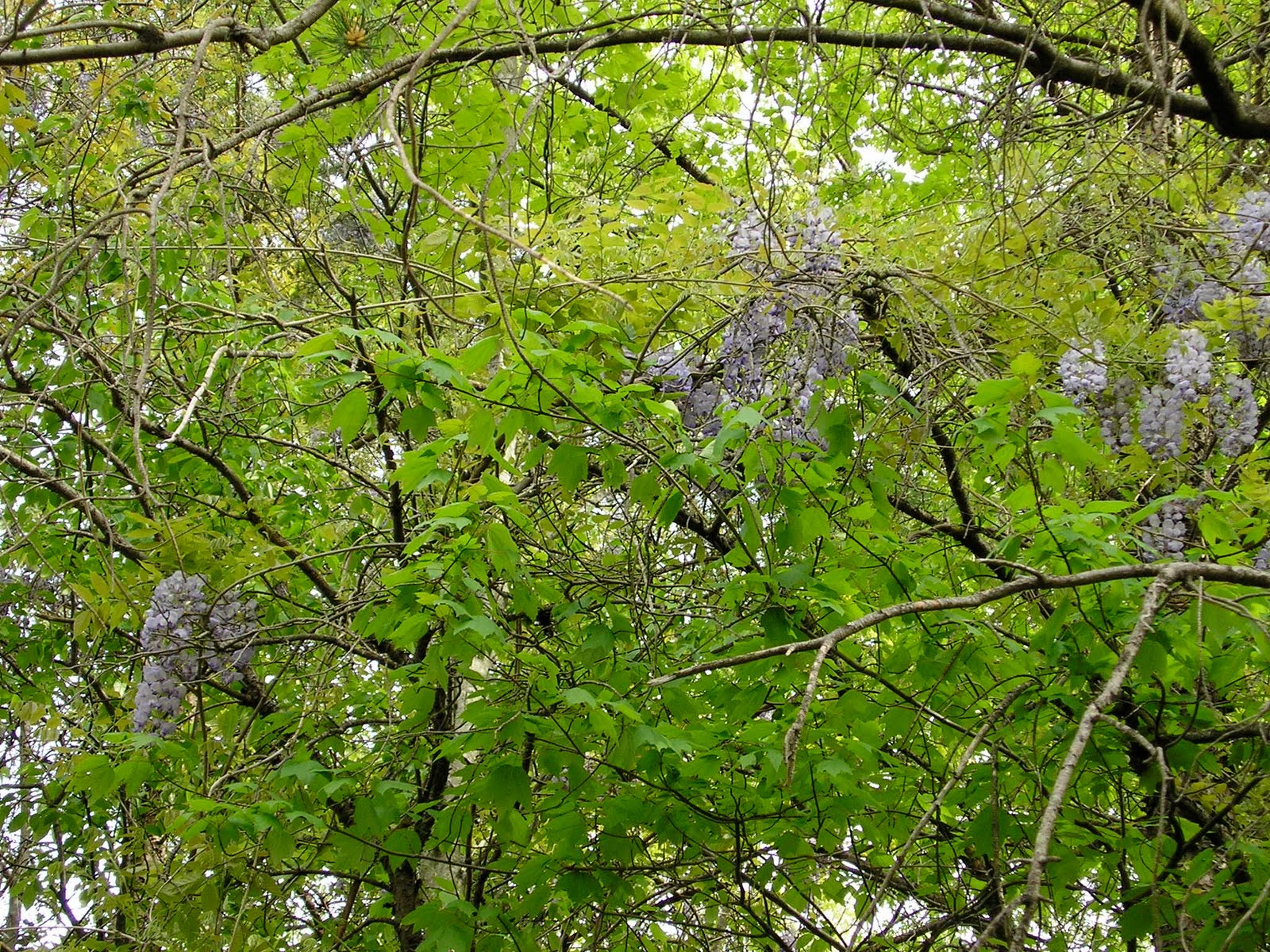
It is now also the season for wisteria (Wisteria spp.) to bloom, as in this specimen at the southwest corner of Sunrise Valley Drive and Cross School Road. Wisteria are highly invasive vines and are among the eight prohibited plants in Reston.
I am not really able to tell whether this is Chinese wisteria (W. sinensis - see this Virginia Tech fact sheet) or Japanese wisteria (W. floribunda - see this Virginia Tech fact sheet). The most definitive distinguishing characteristic appears to be the direction in which the vines twine, but I was not able to observe any twining.
However, it would appear that all flowers on the raceme opened at the same time, which would suggest Chinese wisteria.
In open patches of uncultivated grassland, such as this spot between Robert Fulton Drive and the W&OD bike path just north of Sunset Hills Drive, there is also a profusion of this showy yellow plant.
This is common winter cress (Barbarea vulgaris), also known as "yellow rocket" - see this Connecticut description and this Missouri one. This particular specimen was photographed in the early morning of April 20 along the W&OD bike path north of Sunrise Hills Road. Note the four-lobed flower and the sessile leaves.
Along the W&OD path one now also frequently encounters this erect, fast-growing plant with opposite, squarish leaves that closely hug the stem. This is common milkweed (Asclepias syriaca), so named for the milky sap of its main stem. See this Missouri description, this Virginia Tech weed guide, and this Wikipedia entry.
Added by edit on June 6: This is not milkweed, but rather Indian hemp (Apocynum cannabinum). Both have opposite elliptical leaves that cling to a single stem when emerging, but the Indian hemp is more gracile, with leaves spread farther apart.
In certain favored spots, such as here on the slope between Robert Fulton Drive and the W&OD bike path north of the winter cress meadow previously shown, the milkweed forms rather extensive thickets.
Along the W&OD gravel path, as here between Sunrise Valley Drive and the Dulles Toll Road, the Virginia pine (Pinus virginiana) is also spectacularly in "bloom", with the male strobili fully developed and ready to shed their pollen.
This image shows some of the new strobili adjacent to several old female cones that have long ago dropped their seeds. Note the recurved spines on each scale of the cones, which are characteristic of this species, together with the short, paired needles.
It is now also the season for wisteria (Wisteria spp.) to bloom, as in this specimen at the southwest corner of Sunrise Valley Drive and Cross School Road. Wisteria are highly invasive vines and are among the eight prohibited plants in Reston.
I am not really able to tell whether this is Chinese wisteria (W. sinensis - see this Virginia Tech fact sheet) or Japanese wisteria (W. floribunda - see this Virginia Tech fact sheet). The most definitive distinguishing characteristic appears to be the direction in which the vines twine, but I was not able to observe any twining.
However, it would appear that all flowers on the raceme opened at the same time, which would suggest Chinese wisteria.
In open patches of uncultivated grassland, such as this spot between Robert Fulton Drive and the W&OD bike path just north of Sunset Hills Drive, there is also a profusion of this showy yellow plant.
This is common winter cress (Barbarea vulgaris), also known as "yellow rocket" - see this Connecticut description and this Missouri one. This particular specimen was photographed in the early morning of April 20 along the W&OD bike path north of Sunrise Hills Road. Note the four-lobed flower and the sessile leaves.
Along the W&OD path one now also frequently encounters this erect, fast-growing plant with opposite, squarish leaves that closely hug the stem. This is common milkweed (Asclepias syriaca), so named for the milky sap of its main stem. See this Missouri description, this Virginia Tech weed guide, and this Wikipedia entry.
Added by edit on June 6: This is not milkweed, but rather Indian hemp (Apocynum cannabinum). Both have opposite elliptical leaves that cling to a single stem when emerging, but the Indian hemp is more gracile, with leaves spread farther apart.
In certain favored spots, such as here on the slope between Robert Fulton Drive and the W&OD bike path north of the winter cress meadow previously shown, the milkweed forms rather extensive thickets.
Along the W&OD gravel path, as here between Sunrise Valley Drive and the Dulles Toll Road, the Virginia pine (Pinus virginiana) is also spectacularly in "bloom", with the male strobili fully developed and ready to shed their pollen.
This image shows some of the new strobili adjacent to several old female cones that have long ago dropped their seeds. Note the recurved spines on each scale of the cones, which are characteristic of this species, together with the short, paired needles.
Sunday, March 7, 2010
Morning of March 7, 2010 (continued)
Buds ready to burst forth on a deciduous magnolia on the north side of the W&OD bike path east of Old Reston Avenue. This is probably either a Japanese magnolia (Magnolia liliiflora) or its hybrid, the saucer magnolia (Magnolia x soulangeana), for which see this Virginia Tech fact sheet.
On the north side of the W&OD bike path, midway between American Dream Way and Isaac Newton Square, one can find a number of these tall bushes that are now bearing a profusion of catkins. I don't know what this might be, though it quite well could be a member of the birch family, perhaps eastern hophornbeam.
Dried fruit husks on a sumac (Rhus spp.) on the south side of the W&OD bike path west of Isaac Newton Square. For a view of sumacs in fruit last fall, see this post.
Dogbane (Apocynum spp.), with its characteristic tuning-fork-like seed pods, in the clump on the south side of the W&OD bike path just east of Wiehle Avenue that was also featured in this post. Most of the seed pods are still closed and dried up; only a few have opened (note the much lighter-colored leaf-like structures in the upper center of the image; these are seed pods that have split open).
On the north side of the W&OD bike path, midway between American Dream Way and Isaac Newton Square, one can find a number of these tall bushes that are now bearing a profusion of catkins. I don't know what this might be, though it quite well could be a member of the birch family, perhaps eastern hophornbeam.
Dried fruit husks on a sumac (Rhus spp.) on the south side of the W&OD bike path west of Isaac Newton Square. For a view of sumacs in fruit last fall, see this post.
Dogbane (Apocynum spp.), with its characteristic tuning-fork-like seed pods, in the clump on the south side of the W&OD bike path just east of Wiehle Avenue that was also featured in this post. Most of the seed pods are still closed and dried up; only a few have opened (note the much lighter-colored leaf-like structures in the upper center of the image; these are seed pods that have split open).
Thursday, October 1, 2009
October 1, 2009
On looking at the vegetation lining the W&OD bike path (as here, just west of Wiehle Avenue), one can't help but notice large blotches of deep red spread among the green.
On closer inspection, these blotches turn out to be large clusters of blackish berries born on purple stalks. Despite their similar color, these are not pokeweed (which are low-crouching shrubs rather than small trees, as these), but rather the fruit of Devil's walking stick (Aralia spinosa). See the Virginia Tech fact sheet.
The reason for its name is evident from this image - don't try touching this trunk!
Another very prickly plant is the Mile-a-minute vine (Persicaria perfoliata), already described in this post. Here it can be seen aggressively covering shrubs and even trees on the north side of the W&OD bike path west of Wiehle Avenue.
As compared to two weeks ago, most of this vine's fruit have now ripened to their characteristic blue color.
Not all the plants along the W&OD bike path are so forbidding. There are, for example, also some nice clumps of goldenrods (Solidago spp.), as here on the south side of the path just east of Old Reston Avenue. According to the Digital Atlas of Virginia Flora, there are 17 species of goldenrods growing in the wild in Fairfax County, and I have not even begun to study the distinctions among the specimens found here in Reston.
This might possibly be rough-stemmed goldenrod (S. rugosa) - see this Connecticut Botanical Society page - or early goldenrod (S. juncea) - see this page from same site. Obviously I need to spend more time paying close attention to these plants.
Another plant displaying some color now is the honeysuckle (Lonicera spp.), which is now bearing juicy red fruit about the same size as the autumn olive. This particular specimen is located near the clump of goldenrods shown in the previous two pictures. The honeysuckle has opposite leaves, while the autumn olive has alternating leaves; moreover, the honeysuckle's red fruit lacks the silvery speckles found on the fruit of the autumn olive.
This is either Amur honeysuckle (L. maackii) - see Virginia Tech data sheet - or Morrow's honeysuckle (L. morrowii) - see Virginia Tech data sheet. Both of these bush honeysuckles are highly invasive imports from Asia and are now on Reston's list of "8 forbidden species" that may not be planted.
Further east along the W&OD bike path, on the south side just east of Wiehle Avenue, is another clump of plants now conspicuously in fruit. The fruit consists of pairs of very long, very thin pods or follicles.
This is dogbane (Apocynum spp.); see this comparable image. There are two species growing in the wild in Fairfax County, spreading dogbane (A. androsaemfolium) and Indian hemp (A. cannabinum); however, I don't believe I will be able to distinguish them until they flower next summer, as the first blooms pink and the second blooms white.
On closer inspection, these blotches turn out to be large clusters of blackish berries born on purple stalks. Despite their similar color, these are not pokeweed (which are low-crouching shrubs rather than small trees, as these), but rather the fruit of Devil's walking stick (Aralia spinosa). See the Virginia Tech fact sheet.
The reason for its name is evident from this image - don't try touching this trunk!
Another very prickly plant is the Mile-a-minute vine (Persicaria perfoliata), already described in this post. Here it can be seen aggressively covering shrubs and even trees on the north side of the W&OD bike path west of Wiehle Avenue.
As compared to two weeks ago, most of this vine's fruit have now ripened to their characteristic blue color.
Not all the plants along the W&OD bike path are so forbidding. There are, for example, also some nice clumps of goldenrods (Solidago spp.), as here on the south side of the path just east of Old Reston Avenue. According to the Digital Atlas of Virginia Flora, there are 17 species of goldenrods growing in the wild in Fairfax County, and I have not even begun to study the distinctions among the specimens found here in Reston.
This might possibly be rough-stemmed goldenrod (S. rugosa) - see this Connecticut Botanical Society page - or early goldenrod (S. juncea) - see this page from same site. Obviously I need to spend more time paying close attention to these plants.
Another plant displaying some color now is the honeysuckle (Lonicera spp.), which is now bearing juicy red fruit about the same size as the autumn olive. This particular specimen is located near the clump of goldenrods shown in the previous two pictures. The honeysuckle has opposite leaves, while the autumn olive has alternating leaves; moreover, the honeysuckle's red fruit lacks the silvery speckles found on the fruit of the autumn olive.
This is either Amur honeysuckle (L. maackii) - see Virginia Tech data sheet - or Morrow's honeysuckle (L. morrowii) - see Virginia Tech data sheet. Both of these bush honeysuckles are highly invasive imports from Asia and are now on Reston's list of "8 forbidden species" that may not be planted.
Further east along the W&OD bike path, on the south side just east of Wiehle Avenue, is another clump of plants now conspicuously in fruit. The fruit consists of pairs of very long, very thin pods or follicles.
This is dogbane (Apocynum spp.); see this comparable image. There are two species growing in the wild in Fairfax County, spreading dogbane (A. androsaemfolium) and Indian hemp (A. cannabinum); however, I don't believe I will be able to distinguish them until they flower next summer, as the first blooms pink and the second blooms white.
Subscribe to:
Posts (Atom)