The kousa dogwood (Cornus kousa) at the end of Charter Oak Court is now in full glorious bloom. For how this very tree looked last September at the height of its fruiting, see this post.
A closer look at the kousa flowers. These two pictures of the kousa were taken in the evening of May 6, 2010.
At the southeastern corner of Temporary Road park, where the service road intersects North Shore Drive, is a group of shrubs with showy five-petaled pink flowers, as shown in this photo from April 25, 2010. The compound leaves with usually 7 small leaflets suggest that this is a rose. Note also that the stems are extremely thorny. I believe this may be a rugosa rose (Rosa rugosa, see this Virginia Tech fact sheet and the Missouri description).
The tulip trees (Liriodendron tulipifera) are now in full bloom, as here on May 7, 2010, in the Ivy Square townhouse development.
And the eastern white pines (Pinus strobus) are finally developing their male strobili. Compare this image taken May 7, 2010, in the Ivy Square townhouse development with this post from exactly two weeks previously.
Friday, May 7, 2010
Early Afternoon of May 7, 2010
On the west side of the W&OD bike path, just south of its intersection with Sunset Hills Road, is this tall white-flowering shrub. On closer inspection, though, the flowers turn out to have four rather than five petals, and the leaves are simple rather than compound, so this is neither a blackberry nor a rose.
Instead, it is a form of mockorange (Philadelphus spp.). Given the prominent yellow anthers in the flowers, the lack of serration on the leaves, and the shape of the dried four-valved seed capsules visible in this image, this may very well be sweet mockorange (P. coronarius, see this Virginia Tech data sheet and this Connecticut disquisition).
In the median between the W&OD bike path and the W&OD gravel path, immediately south of their intersection with Sunset Hills Road, is this inconspicuous plant with small four-petaled flowers. It is difficult to see in this image, but the leaves are sessile or even clasping. This appears to be a member of the mustard family (Brassica spp.), of which only two species are listed by the Digital Atlas of Virginia Flora as occurring in Fairfax County, and since of those two B. nigra has petiolate leaves, it appears that, by process of elimination, this is a turnip (B. rapa, see this Vanderbilt description). The spiny-appearing upward-pointing projections below the flowers, incidentally, are not leaves or bracts, but rather siliques, which are the characteristic fruits of the mustard family.
Hidden on the east side of the W&OD gravel path north of its intersection with Sunset Hills Road is this inconspicuous plant with blue six-petaled flowers. The leaves look all the world like grass leaves, which is reflected in the plant's name blue-eyed grass (Sisyrinchium spp., see this Wikipedia article), but this is not actually a grass, but rather a relative of the irises and lilies.
On the north side of the W&OD gravel path just east of its intersection with Michael Faraday Drive is a whole row of fleabanes (Erigeron spp.) getting ready to bloom. Given that the ray flowers are white rather than pink, this could be either E. annuus (see Missouri description) or E. strigosus (see Missouri description).
This small ground-covering plant with its characteristic pinnately compound leaves with around 20 leaflets is ubiquitous along the W&OD path. This particular specimen on the north side of the bike path just west of its intersection with Isaac Newton Square has now started blooming. This is crown vetch (Coronilla varia, see the Missouri description), which is a member of the Fabaceae or Pea family, just like the black locust that has similarly-shaped leaves.
Instead, it is a form of mockorange (Philadelphus spp.). Given the prominent yellow anthers in the flowers, the lack of serration on the leaves, and the shape of the dried four-valved seed capsules visible in this image, this may very well be sweet mockorange (P. coronarius, see this Virginia Tech data sheet and this Connecticut disquisition).
In the median between the W&OD bike path and the W&OD gravel path, immediately south of their intersection with Sunset Hills Road, is this inconspicuous plant with small four-petaled flowers. It is difficult to see in this image, but the leaves are sessile or even clasping. This appears to be a member of the mustard family (Brassica spp.), of which only two species are listed by the Digital Atlas of Virginia Flora as occurring in Fairfax County, and since of those two B. nigra has petiolate leaves, it appears that, by process of elimination, this is a turnip (B. rapa, see this Vanderbilt description). The spiny-appearing upward-pointing projections below the flowers, incidentally, are not leaves or bracts, but rather siliques, which are the characteristic fruits of the mustard family.
Hidden on the east side of the W&OD gravel path north of its intersection with Sunset Hills Road is this inconspicuous plant with blue six-petaled flowers. The leaves look all the world like grass leaves, which is reflected in the plant's name blue-eyed grass (Sisyrinchium spp., see this Wikipedia article), but this is not actually a grass, but rather a relative of the irises and lilies.
On the north side of the W&OD gravel path just east of its intersection with Michael Faraday Drive is a whole row of fleabanes (Erigeron spp.) getting ready to bloom. Given that the ray flowers are white rather than pink, this could be either E. annuus (see Missouri description) or E. strigosus (see Missouri description).
This small ground-covering plant with its characteristic pinnately compound leaves with around 20 leaflets is ubiquitous along the W&OD path. This particular specimen on the north side of the bike path just west of its intersection with Isaac Newton Square has now started blooming. This is crown vetch (Coronilla varia, see the Missouri description), which is a member of the Fabaceae or Pea family, just like the black locust that has similarly-shaped leaves.
Morning of May 7, 2010
White clover (Trifolium repens, see this Missouri description and this Virginia Tech weed guide) is in bloom across Reston now. This particular clump is in front of the Exxon station at the intersection of Wiehle Avenue and Isaac Newton Square.
Also very prominent now alongside paths and in unmown areas is this relatively tall grass with distinctive thick seedheads that form a triangular plane. This particular sample is on the east side of Wiehle Avenue just north of its intersection with the W&OD bike path. Also highlighted by the low sun in this image are some smaller grasses of a different species that I have not yet been able to identify, but which may be a form of Poa spp.
Here is another specimen from further south along the W&OD bike path. It is a bit farther along in its development, with anthers now protruding from the seedheads. I believe this grass is orchard grass (Dactylis glomerata); compare this Missouri description and this Wikipedia article.
On either side of the W&OD bike path, as here just east of Michael Faraday Drive, large thickets of blackberries (Rubus spp.) are now in bloom.
Not all flowers on a cane bloom at the same time (some of the flowers in this image have already lost their petals); if they did, this would be even more spectacular. Note that complete flowers have five relatively large elongated petals, and the leaves generally are composed of three leaflets. This may be southern or sawtooth blackberry (R. argutus, see this Virginia Tech fact sheet, this Duke description, and this Missouri description).
At the same time, there is another thicket-forming shrub that is at the peak of bloom, as here on the north side of the W&OD bike path just east of Michael Faraday Drive. This is the multiflora rose (Rosa multiflora), a highly invasive species (see this Virginia Tech fact sheet and this National Park Service indictment). For an image from last October of the red berries born by the multiflora rose, see this post.
A close-up of the multiflora rose. Unlike with the blackberries, all of the flowers on the rose are blooming at the same time. Also, the white petals are a bit wider and less elongated, and the flowers have prominent clusters of yellow stamens at their center, unlike the blackberry flowers. Finally, the leaves have 7 to 9 rather smaller leaflets. Thus, even though both the multiflora rose and the blackberry belong to the Rosaceae family (along with cherries, pears and apples), they are easily distinguishable.
This grape vine (Vitis spp.), on the west side of the W&OD bike path just south of Sunset Hills Road, is now also in bloom, albeit very inconspicuously.
Also very prominent now alongside paths and in unmown areas is this relatively tall grass with distinctive thick seedheads that form a triangular plane. This particular sample is on the east side of Wiehle Avenue just north of its intersection with the W&OD bike path. Also highlighted by the low sun in this image are some smaller grasses of a different species that I have not yet been able to identify, but which may be a form of Poa spp.
Here is another specimen from further south along the W&OD bike path. It is a bit farther along in its development, with anthers now protruding from the seedheads. I believe this grass is orchard grass (Dactylis glomerata); compare this Missouri description and this Wikipedia article.
On either side of the W&OD bike path, as here just east of Michael Faraday Drive, large thickets of blackberries (Rubus spp.) are now in bloom.
Not all flowers on a cane bloom at the same time (some of the flowers in this image have already lost their petals); if they did, this would be even more spectacular. Note that complete flowers have five relatively large elongated petals, and the leaves generally are composed of three leaflets. This may be southern or sawtooth blackberry (R. argutus, see this Virginia Tech fact sheet, this Duke description, and this Missouri description).
At the same time, there is another thicket-forming shrub that is at the peak of bloom, as here on the north side of the W&OD bike path just east of Michael Faraday Drive. This is the multiflora rose (Rosa multiflora), a highly invasive species (see this Virginia Tech fact sheet and this National Park Service indictment). For an image from last October of the red berries born by the multiflora rose, see this post.
A close-up of the multiflora rose. Unlike with the blackberries, all of the flowers on the rose are blooming at the same time. Also, the white petals are a bit wider and less elongated, and the flowers have prominent clusters of yellow stamens at their center, unlike the blackberry flowers. Finally, the leaves have 7 to 9 rather smaller leaflets. Thus, even though both the multiflora rose and the blackberry belong to the Rosaceae family (along with cherries, pears and apples), they are easily distinguishable.
This grape vine (Vitis spp.), on the west side of the W&OD bike path just south of Sunset Hills Road, is now also in bloom, albeit very inconspicuously.
Wednesday, May 5, 2010
Small wonders - late afternoon, April 28, 2010
On the east side of the W&OD bike path, just across from the small picnic area south of the Dulles Toll Road, is this isolated little plant with compound flowers composed of a yellow disk in the center and pinkish white rays on the outside.
A close-up of some of the flowers - note the sheer number of small rays on each flower. This is a fleabane, and specifically appears to be a Philadelphia fleabane (Erigeron philadelphicus), based on the pinkish coloration of the rays, the sessile leaves, and the rather hairy stems. See this Missouri description, this Connecticut discussion, and this Illinois disquisition.
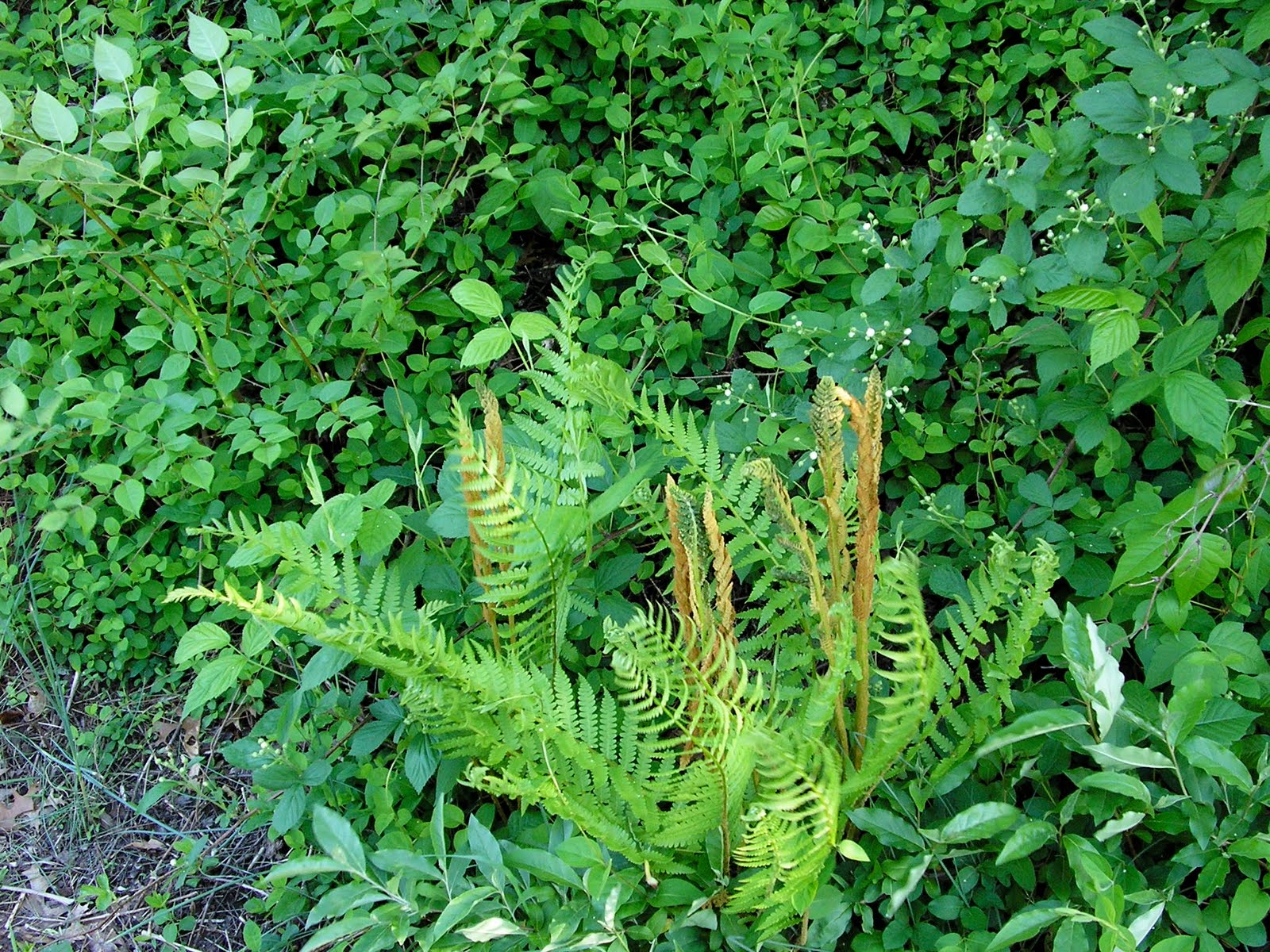
Cinnamon fern (Osmundastrum cinnamomeum) on the north-facing southern slope of the W&OD bike path between Wiehle Avenue and Isaac Newton Square. Note the characteristic stick-like brown frond in the center, which bears the sori that will produce the reproductive spores, and the surrounding green fronds, which are sterile.
Another nearby clump of cinnamon fern. Compare to this post from half a month ago showing the fronds still rolled up in fiddleheads.
A thicket of blackberries (Rubus spp.) erupting into white-petaled bloom north of the W&OD bike path between the Oak Hill Christian School driveway and the pipeline easement. As this Missouri site points out, arching Rubus species can be extremely difficult to distinguish; thus, I will keep it to the generic "blackberry".
A beautiful meadow-effect created by the dispersion of innumerable buttercups (Ranunculus spp.) in the grass that covers the pipeline easement where it crosses the W&OD gravel path (to the left) and W&OD bike path (to the right).
Finally, this little patch along the W&OD bike path across from the Fannie Mae Gardens just east of Old Reston Avenue features both ground ivy (Glechoma hederacea) and red deadnettle (Lamium purpureum), allowing the blue/purple flowers of these two ground-covering weeds to be compared. See this post for an earlier discussion of these two species, as well as the buttercup and the dandelions also visible in this image.
A close-up of some of the flowers - note the sheer number of small rays on each flower. This is a fleabane, and specifically appears to be a Philadelphia fleabane (Erigeron philadelphicus), based on the pinkish coloration of the rays, the sessile leaves, and the rather hairy stems. See this Missouri description, this Connecticut discussion, and this Illinois disquisition.
Cinnamon fern (Osmundastrum cinnamomeum) on the north-facing southern slope of the W&OD bike path between Wiehle Avenue and Isaac Newton Square. Note the characteristic stick-like brown frond in the center, which bears the sori that will produce the reproductive spores, and the surrounding green fronds, which are sterile.
Another nearby clump of cinnamon fern. Compare to this post from half a month ago showing the fronds still rolled up in fiddleheads.
A thicket of blackberries (Rubus spp.) erupting into white-petaled bloom north of the W&OD bike path between the Oak Hill Christian School driveway and the pipeline easement. As this Missouri site points out, arching Rubus species can be extremely difficult to distinguish; thus, I will keep it to the generic "blackberry".
A beautiful meadow-effect created by the dispersion of innumerable buttercups (Ranunculus spp.) in the grass that covers the pipeline easement where it crosses the W&OD gravel path (to the left) and W&OD bike path (to the right).
Finally, this little patch along the W&OD bike path across from the Fannie Mae Gardens just east of Old Reston Avenue features both ground ivy (Glechoma hederacea) and red deadnettle (Lamium purpureum), allowing the blue/purple flowers of these two ground-covering weeds to be compared. See this post for an earlier discussion of these two species, as well as the buttercup and the dandelions also visible in this image.
Sunday, April 25, 2010
White flowers (and a couple of yellow ones) - April 25, 2010
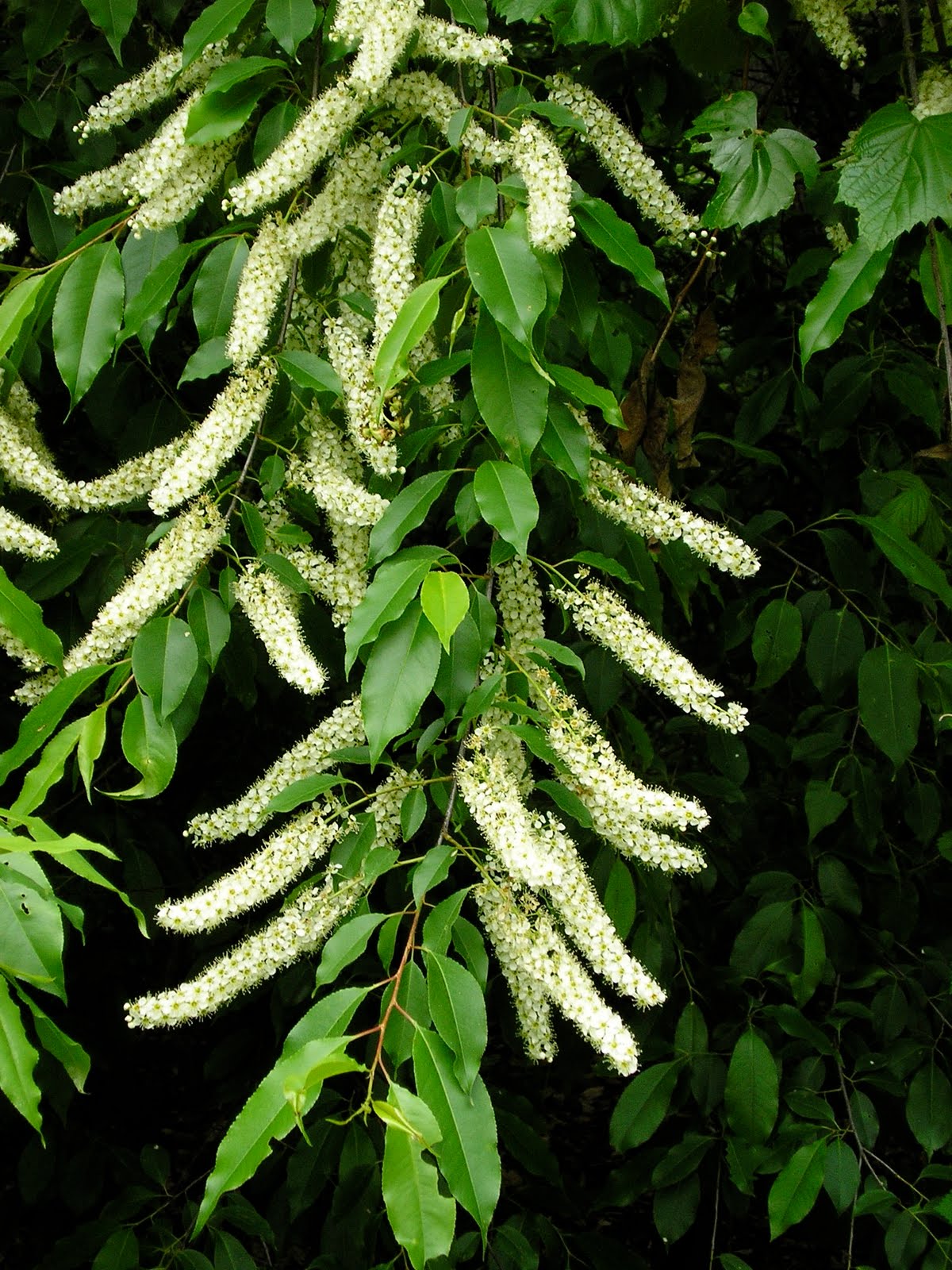
Another tree that is blooming spectacularly right now is the black cherry (Prunus serotina - see the Virginia Tech fact sheet). This is a native cherry that grows much taller and blooms rather later than the imported Japanese ornamental varieties. This particular specimen is in the northwestern-most corner of the Charter Oak apartment complex.
Those little white dashes that could be seen in the overview picture? Each one is a panicle full of white five-petaled flowers.
Across North Shore Drive, on the southeastern corner of Temporary Road Park, are these ornamental viburnums, which are almost certainly doublefile viburnum (Viburnum plicatum, see the Virginia Tech fact sheet).
Looking closer at the flower clusters, one can see the large flowers along the outside of each cluster; these large ones are sterile - they lack pistils and stamens, and consist only of petals.
Just north of the intersection of Sycamore Valley Drive with North Shore Drive is this black locust (Robinia pseudoacacia) tree, which allows me a better shot at the drooping white flower clusters than I was able to get day-before-yesterday.
At the edge of the basketball court on North Shore Drive near the border between the Sycamores apartment complex and the Ivy Square condo complex, I found this tiny yellow flower with a very distinctive leaf pattern - three heart-shaped leaves joined at their apex.
Here is another sample, from a meadow in the Charter Oak townhouse complex (this one also properly shows that the flower has five petals). This is a yellow woodsorrel (Oxalis spp.), either common yellow woodsorrel (Oxalis stricta, see this Missouri description) or southern yellow woodsorrel (Oxalis dillenii, see this Missouri description). I am leaning toward believing it to be the latter, as the flowers do seem to be solitary rather than branched.
Just north of the entrance to the Charter Oak townhouse complex is this fringe tree (Chionanthus virginicus, see the Virginia Tech fact sheet). This appears to be a favorite ornamental of local transit agencies; one frequently sees them at Park-and-Ride and Metro station parking lots.
A somewhat closer look at the long stringy white petals which give the fringe tree its name.
Just north of the fringe tree is this ornamental viburnum, which, like the doublefile viburnum pictured earlier, has a ring of sterile flowers ringing the outside of each flower cluster, but which also has three-lobed rather than simple leaves. This appears to be highbush-cranberry (Viburnum opulus var. americanum, see this Vanderbilt description and the Virginia Tech fact sheet). And yes, that is a honeysuckle at the very left of the image.
Finally, I found this small yellow flower (a bit bleached in flashlight) underneath the hollies on the walkway connecting the Charter Oak townhouse complex with the Charter Oak apartments. Note the prominent green sepals separating the five yellow petals, and the trifoliolate compound leaves with rounded serrations. I believe this may be mock strawberry (Duchesnea indica, see this Missouri description), which is closely related to the cinquefoils (Potentilla spp.).
Those little white dashes that could be seen in the overview picture? Each one is a panicle full of white five-petaled flowers.
Across North Shore Drive, on the southeastern corner of Temporary Road Park, are these ornamental viburnums, which are almost certainly doublefile viburnum (Viburnum plicatum, see the Virginia Tech fact sheet).
Looking closer at the flower clusters, one can see the large flowers along the outside of each cluster; these large ones are sterile - they lack pistils and stamens, and consist only of petals.
Just north of the intersection of Sycamore Valley Drive with North Shore Drive is this black locust (Robinia pseudoacacia) tree, which allows me a better shot at the drooping white flower clusters than I was able to get day-before-yesterday.
At the edge of the basketball court on North Shore Drive near the border between the Sycamores apartment complex and the Ivy Square condo complex, I found this tiny yellow flower with a very distinctive leaf pattern - three heart-shaped leaves joined at their apex.
Here is another sample, from a meadow in the Charter Oak townhouse complex (this one also properly shows that the flower has five petals). This is a yellow woodsorrel (Oxalis spp.), either common yellow woodsorrel (Oxalis stricta, see this Missouri description) or southern yellow woodsorrel (Oxalis dillenii, see this Missouri description). I am leaning toward believing it to be the latter, as the flowers do seem to be solitary rather than branched.
Just north of the entrance to the Charter Oak townhouse complex is this fringe tree (Chionanthus virginicus, see the Virginia Tech fact sheet). This appears to be a favorite ornamental of local transit agencies; one frequently sees them at Park-and-Ride and Metro station parking lots.
A somewhat closer look at the long stringy white petals which give the fringe tree its name.
Just north of the fringe tree is this ornamental viburnum, which, like the doublefile viburnum pictured earlier, has a ring of sterile flowers ringing the outside of each flower cluster, but which also has three-lobed rather than simple leaves. This appears to be highbush-cranberry (Viburnum opulus var. americanum, see this Vanderbilt description and the Virginia Tech fact sheet). And yes, that is a honeysuckle at the very left of the image.
Finally, I found this small yellow flower (a bit bleached in flashlight) underneath the hollies on the walkway connecting the Charter Oak townhouse complex with the Charter Oak apartments. Note the prominent green sepals separating the five yellow petals, and the trifoliolate compound leaves with rounded serrations. I believe this may be mock strawberry (Duchesnea indica, see this Missouri description), which is closely related to the cinquefoils (Potentilla spp.).
Saturday, April 24, 2010
Understory - April 23, 2010
North of the W&OD gravel path, between the pipeline easement and American Dream Way, is this rather tall flowering herb with very serrated opposite triangular leaves, four-petaled white flowers, and spiny bracts. This appears to be garlic mustard (Alliaria petiolata, see this Missouri description), which is considered a bad invasive plant (see this link).
Nearby is this specimen, which has denser, less serrated leaves and no bracts, but I believe it may still be the same species.
On the south side of the W&OD bike path, just east of its intersection with Michael Faraday Drive, is this viburnum bush (Viburnum spp.) that was already featured in full fruit in this post last fall. Back then I suggested this might be wayfaringtree viburnum (V. lantana), although I'm now thinking it might also be leatherleaf viburnum (V. rhytidophyllum, see the Virginia Tech data sheet). Unfortunately, I did not pay attention during the winter as to whether this was evergreen or not.
Nearby is this specimen, which has denser, less serrated leaves and no bracts, but I believe it may still be the same species.
On the south side of the W&OD bike path, just east of its intersection with Michael Faraday Drive, is this viburnum bush (Viburnum spp.) that was already featured in full fruit in this post last fall. Back then I suggested this might be wayfaringtree viburnum (V. lantana), although I'm now thinking it might also be leatherleaf viburnum (V. rhytidophyllum, see the Virginia Tech data sheet). Unfortunately, I did not pay attention during the winter as to whether this was evergreen or not.
Trees - April 23, 2010
While male strobili are already fully developed on Virginia pines (see this post from earlier in the week), they are not yet apparent in Eastern white pine (Pinus strobus). Instead, all we have yet are these new shoots that will eventually develop either male strobili or female cones.
Note, though, how abundant the shoots are, at the end of each branch and branchlet - once the strobili develop, their pollen will be overpowering! This specimen is in the parking lot of 1801 Robert Fulton Drive.
Meanwhile, this blue spruce (Picea pungens) near the entrance to 1801 Robert Fulton Drive (part of the group featured in this post from last fall) is in full "bloom".
Note the solitary male strobili hanging from the ends of the branches. Also barely visible are several mature cones from last year that have already opened up and dropped their seed.
Here one can also see a new cone, still light brown and with its scales relatively closed.
Meanwhile, there is one large flowering tree that is now spectacularly in bloom - the black locust (Robinia pseudoacacia, see the Virginia Tech data sheet).
This specimen, which still has few leaves and thus is almost all white flower right now, is located on the north side of the W&OD gravel path just west of its intersection with the driveway for the Oak Hill Christian School.
This specimen is located along the southern border of the Sycamores apartment complex. It has already leafed out more, showing the characteristic pinnately compound leaves of the black locust. But this also shows a somewhat closer look at the drooping clusters of flowers - rather similar to the wisteria flowers, which is not surprising, given that both are members of the Fabaceae or pea family.
Near the black locust just shown is this black walnut (Juglans nigra), which is also in bloom, albeit not very spectacularly - note the hanging catkins of green male flowers in the center of the image.
A closer view of the black walnut catkins. For a picture of black walnut in fruit last fall, see this post.
Note, though, how abundant the shoots are, at the end of each branch and branchlet - once the strobili develop, their pollen will be overpowering! This specimen is in the parking lot of 1801 Robert Fulton Drive.
Meanwhile, this blue spruce (Picea pungens) near the entrance to 1801 Robert Fulton Drive (part of the group featured in this post from last fall) is in full "bloom".
Note the solitary male strobili hanging from the ends of the branches. Also barely visible are several mature cones from last year that have already opened up and dropped their seed.
Here one can also see a new cone, still light brown and with its scales relatively closed.
Meanwhile, there is one large flowering tree that is now spectacularly in bloom - the black locust (Robinia pseudoacacia, see the Virginia Tech data sheet).
This specimen, which still has few leaves and thus is almost all white flower right now, is located on the north side of the W&OD gravel path just west of its intersection with the driveway for the Oak Hill Christian School.
This specimen is located along the southern border of the Sycamores apartment complex. It has already leafed out more, showing the characteristic pinnately compound leaves of the black locust. But this also shows a somewhat closer look at the drooping clusters of flowers - rather similar to the wisteria flowers, which is not surprising, given that both are members of the Fabaceae or pea family.
Near the black locust just shown is this black walnut (Juglans nigra), which is also in bloom, albeit not very spectacularly - note the hanging catkins of green male flowers in the center of the image.
A closer view of the black walnut catkins. For a picture of black walnut in fruit last fall, see this post.
Subscribe to:
Posts (Atom)